

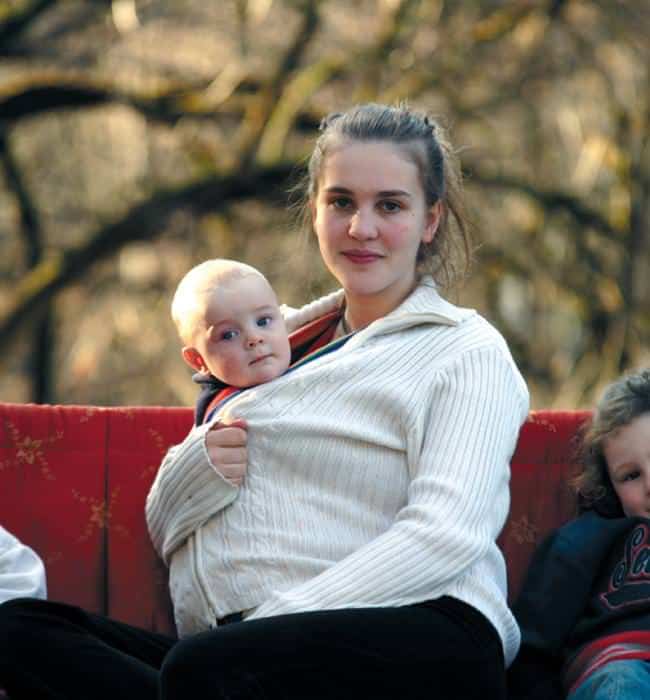
The Tribe of the Likatians (“Der Stamm der Likatier”), is a intentional community of some hundred people in the city of Füssen in Southern Germany. Due to their philosophy, the love between mother and child is a role model for all relations amongst people, and in the community. This is why birth- giving, and the raising of children, is regarded as the most significant event in tribal life.
For Stanislav Grof – with his research on perinatal psychotherapy – and the Tribe of the Likatians, giving birth is a most significant transitional event; one that deeply shapes and influences our lives.
Birth in the Middle of Life
Births in the Tribe usually take place at home. It is only in emergency situations that we need to ask for support from doctors. More than 100 children have been born in the Tribe. Depending on the wishes of the woman giving birth, she will be accompanied by other tribal women (most of whom already have had children), and often by young interested girls, as well as the midwife and, sometimes, the father.
Birth is usually seen as women’s ‘business’. However, fathers sometimes attend at their own request, but usually stay in the background. While a birth in the tribe is not regarded as a private event, it still takes place “in the middle of tribal life.” But, of course, every woman can decide quite freely which people she wants to have by her side at birth.
The women try to be close to the becoming mother, and encourage her to open fully. For the mother, it is often helpful to be in presence of experienced women. Even if it is fully clear that she is the one to do the work, the other women comfort and support her. They can encourage her to overcome fears and go beyond boundaries.
Many young girls have already witnessed births in the tribe. For them, birth-giving is not a sterile event which takes place in an anonymous hospital environment, but is a part of their life in the tribe in which they can collect important experiences towards their own “birthing” as a mother.
Birth and Therapy
During childbirth, the woman is in an exceptional space and a special state of consciousness. Naked in every sense, she gives birth to a child, and naked is the reality for all women in this moment. All her fears and blockages against life become clearly visible. And, at the same time, the birth is a chance to turn more towards life.
The members of the Tribe try during childbirth to allow all emerging feelings. Some wish to have them recorded on tape or video, and usually the women write a report after birth. Based on this material the members of the Tribe work on the structures of their personality.
Times of life transitions are not only crises, but are also of major assistance in the personal growth and development towards more vitality in life.
Birth for the child
For the child, birth is a very drastic experience of crossing a border into life. In the Tribe, the women consciously act to create an environment in which the child is received gently and lovingly into their new world. For example, the child should be able to lie and recover on the belly of the mother as long as possible, as bodily contact and a relaxed atmosphere are important in order for the newborn to arrive into life.
The usual routine in hospitals, with the cutting of the umbilical cord too early – often connected with the trauma of suffocation of the child due to lack of oxygen – along with measuring, weighing, wrapping, dressing, and the first medical interventions such as blood tests and vitamin K prophylaxis, are not practiced within the tribe. The child is still measured, etc., but rather casually, and without the usual coarse separation from the mother.
Based on the latest medical findings, the members of the Tribe also think that vaccinations in the first days after birth are questionable.
Over the next few days, the new child will be visited by many Likatiers, neighbors, friends and relatives, and welcomed into the Tribe. Once the mother is back on her feet, the first ceremony will be held – a name giving ceremony and celebration for the child and family.
Keep the conversation going with these pieces
There are no available blogs
Subscribe to our newsletter for fresh stories and ecovillage updates delivered to your inbox.
Get Plus and connect deeper with direct messaging, vetted content, private groups, and more.
We use cookies to improve your experience on our site. By using our site, you consent to cookies.
Manage your cookie preferences below:
Essential cookies enable basic functions and are necessary for the proper function of the website.
CleanTalk offers effective spam protection and website security solutions to enhance user experience.
Service URL: cleantalk.org (opens in a new window)
These cookies are needed for adding comments on this website.
These cookies are used for managing login functionality on this website.
Statistics cookies collect information anonymously. This information helps us understand how visitors use our website.
Google Analytics is a powerful tool that tracks and analyzes website traffic for informed marketing decisions.
Service URL: policies.google.com (opens in a new window)
A residential project: people live here as their primary home.
An institution, business, network, or project that isn’t a residence (e.g. a learning center, farm, or network with no one living there full-time).

{{ item.label }}
{{ item.value ? item.value : currencyFormat( item.amount ) }}
Subtotal
{{ currencyFormat( pricing_summary.total_amount ) }}
There are no results matching your search

