

In 2011, Japan experienced a mega-earthquake with a resulting tsunami in the vast northeastern area of the country. Hiroko Katayama from the urban ecovillage, As-One, reports on the observation that the mutual support among victims is more sustainable when they can maintain money-free exchanges.
In March 2011, the nuclear power plants on the seashore of Fukushima experienced a meltdown. Since that time, large amounts of radiation have been leaking from the sites into the atmosphere, the ocean and the land. After four years, the problems all over Japan are still difficult and the fallout from the accidents and incidents following the tsunami have made many citizens depressed and disillusioned. This has led to the emergence of new collaborations, such as the ‘EBook’ of ecovillages; the New Movement map; and Transition Town networking, as I reported in the last international news (March, June).
As-One Community is one of these collaborations, started at the end of 2000. People are regarding it as ‘an open-style urban ecovillage’. Since study tours have been offered, the participants have been increasing in number. Some of them are from the disaster areas. They frequently ask us how people can maintain reliable relationships. I think this question is the essential factor in understanding exactly what it is that people require of ecovillages, especially in the case of emergency or crisis. I will try to review and consider this factor from our experience.
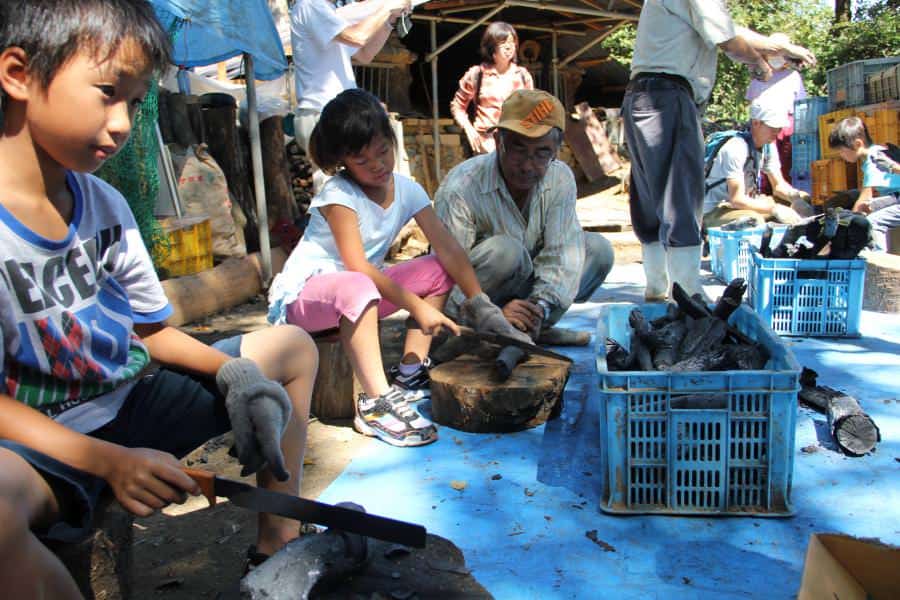
Of course, in any emergency practical solutions are required, such as mini-solar-powered generation systems for personal mobiles and lights. This is very important both for morale and search and rescue after a severe disaster. One social model that is often used by ecovillages, is the money-free shop where people can obtain the things they need in a disaster, co-operatively. This requires a degree of collaboration between members of the community, other local people, and government. Participants have been surprised by this collaboration, for example, where the Farming Park and Forest Park have been developed as open spaces in the event of an emergency evacuation; where everyone has access to clean well water and to traditional charcoal for fuel; and where everyone from all age groups can meet other people and work together in a non-competitive and friendly way which is vital in times of disaster.
However, almost of all of the tour participants focus on the challenge of how As-One Community has been able to nurture and maintain healthy relationships amongst members and also with the local people for fifteen years, even though many trials and errors were experienced.
I felt it necessary therefore to interview some participants of the study tours who came from disaster affected areas.
Ohtsuchi is a town on the seashore, where 1277 people were affected by the disaster, including the mayor and 32 town staff. Efforts have been made to support the townspeople back to normal conditions; however, as of September 2015, many people are still living in temporary shelters. An assistant staffer, Yaeko says, “Everyone works hard with sincerity but the conditions are still severe. The staff are exhausted. The main difficulty seems to come from human relationships and money problems. Yaeko goes on to say that people complain and claim they are being treated unfairly, that some people receive more and better services than others.
Mr. Naomi Yoshida, a leader of a supporting group in Morioka city, points out that the same situations as Otsuchi are happening in almost of all disaster areas: “Immediately after the tsunami, people support each other peacefully. After several days, when goods were supplied and money started circulating gradually, the peaceful self-supporting condition among sufferers has totally changed to struggles for more share than others. Dissatisfaction and mistrust have spread among people. It has become difficult for people to do anything without money even in an emergency situation”.
In the face of this, Yoshida focused on how people could work together for reparation fairly, without money. He searched for examples free from monetary systems. One of them was As-One Community: “When I stayed there in 2012, although I could not understand very well in just three days about the whole system, I could be sure that they were free as individuals and they supported each other. Since then, Yoshida has started self-supporting farming and regular meeting with people in Morioka city. He will keep conversing with citizens on his site. Yoshida says, “It is necessary for people that there are several alternative systems of society. Ecovillage systems work and provide possible goals for humanity and society.”
It is in the very nature of people to keep conversations going under any conditions. However, it depends on the quality of conversation for people to be able to share the results willingly and happily.
Here are some interesting considerations on the sustainable conversation. Though they are not from disaster areas but from different cultural regions, I would still like to mention them as they are very relevant.
Pedro Araujo Mendes, a lecturer of Gaia Education and facilitator of Dragon Dreaming in Brasil, has stayed in the As-One Community for one month, in order to learn the Scienz, an approach based on the observation of reality, which was born from out of real processes of community building. Scienz is an abbreviation of Scientific Investigation of Essential Nature + Zero. Pedro says, “Objectivity is essential to build sustainable relationship through conversations. Scienz can allow us to have objectivity, which accelerates the ability to understand each other.”
Other Brasilians, Jane and Itamar say, “Relationship among people directly influences relationship with nature. When we worked on farming with younger Japanese here in the morning, we open each mind and looking into each self. We continued the conversation noting that is an easy process, young boys do it all the time, it is interesting and useful to get to know about each other and how we react with other people. ”
Pedoro Mendes adds, “Of course I don’t deny so-called any “mysticism”. However, we need more an objective viewpoint and attitude when we live with a wider range of people.
On August 30th, more than a hundred thousand citizens, including high school students and people with disabilities gathered to express their own opinion to the government around the National Assembly building in Tokyo. It was a honest expression. It shows that Japanese have gradually established each identity and can operate together in collaboration.
I think Ecovillage systems and expertise can practically demonstrate how we can be independent from the community as individuals, but also how we can work together peacefully to propose possible models for all citizens, by engaging in the sustainable conversation. We need to continue this investigation and conversation on the essential nature of humans and our societies with a diverse range of people for the common good.
Keep the conversation going with these pieces
There are no available blogs
Subscribe to our newsletter for fresh stories and ecovillage updates delivered to your inbox.
Get Plus and connect deeper with direct messaging, vetted content, private groups, and more.
We use cookies to improve your experience on our site. By using our site, you consent to cookies.
Manage your cookie preferences below:
Essential cookies enable basic functions and are necessary for the proper function of the website.
CleanTalk offers effective spam protection and website security solutions to enhance user experience.
Service URL: cleantalk.org (opens in a new window)
These cookies are needed for adding comments on this website.
These cookies are used for managing login functionality on this website.
Statistics cookies collect information anonymously. This information helps us understand how visitors use our website.
Google Analytics is a powerful tool that tracks and analyzes website traffic for informed marketing decisions.
Service URL: policies.google.com (opens in a new window)
A residential project: people live here as their primary home.
An institution, business, network, or project that isn’t a residence (e.g. a learning center, farm, or network with no one living there full-time).

{{ item.label }}
{{ item.value ? item.value : currencyFormat( item.amount ) }}
Subtotal
{{ currencyFormat( pricing_summary.total_amount ) }}
There are no results matching your search

