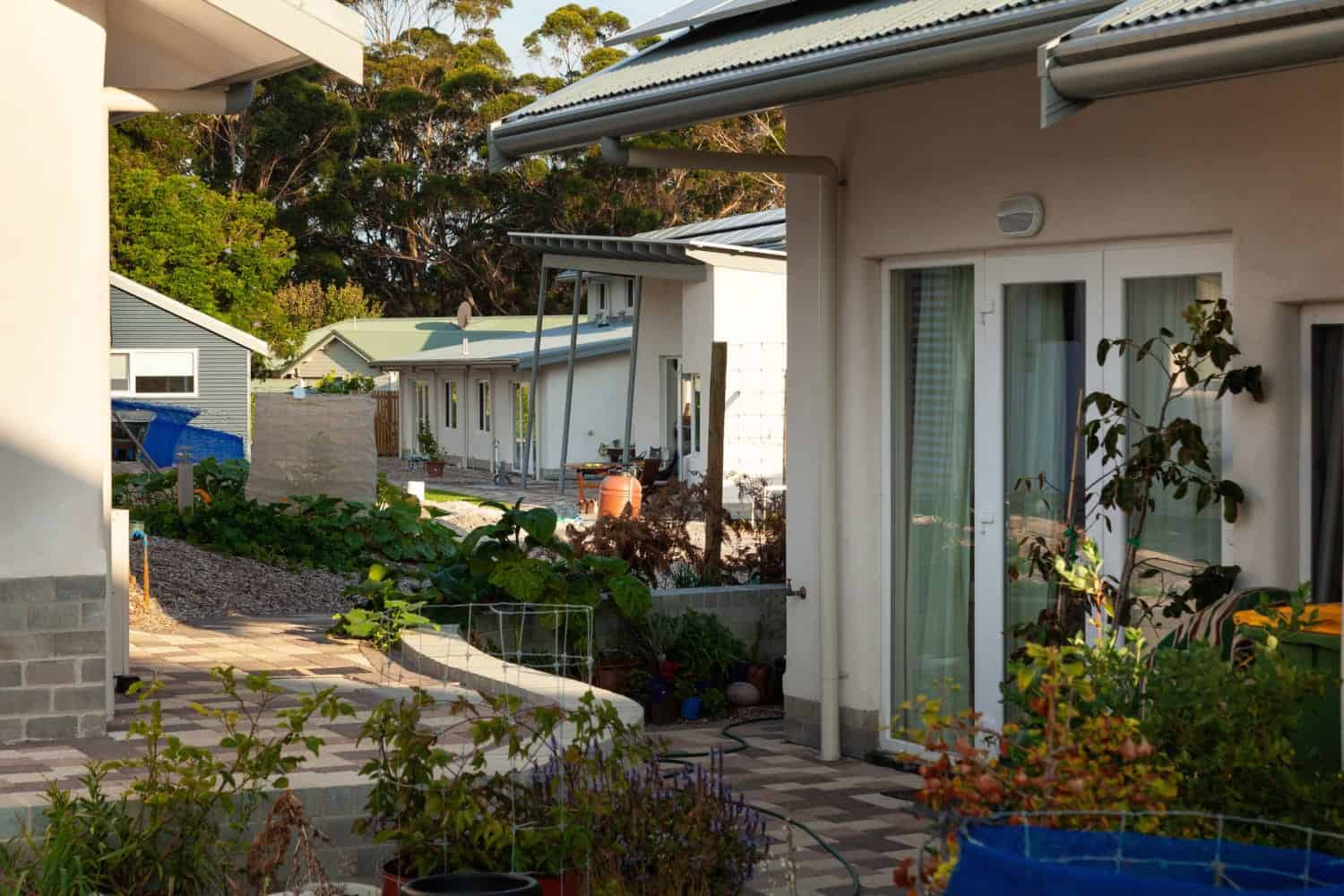
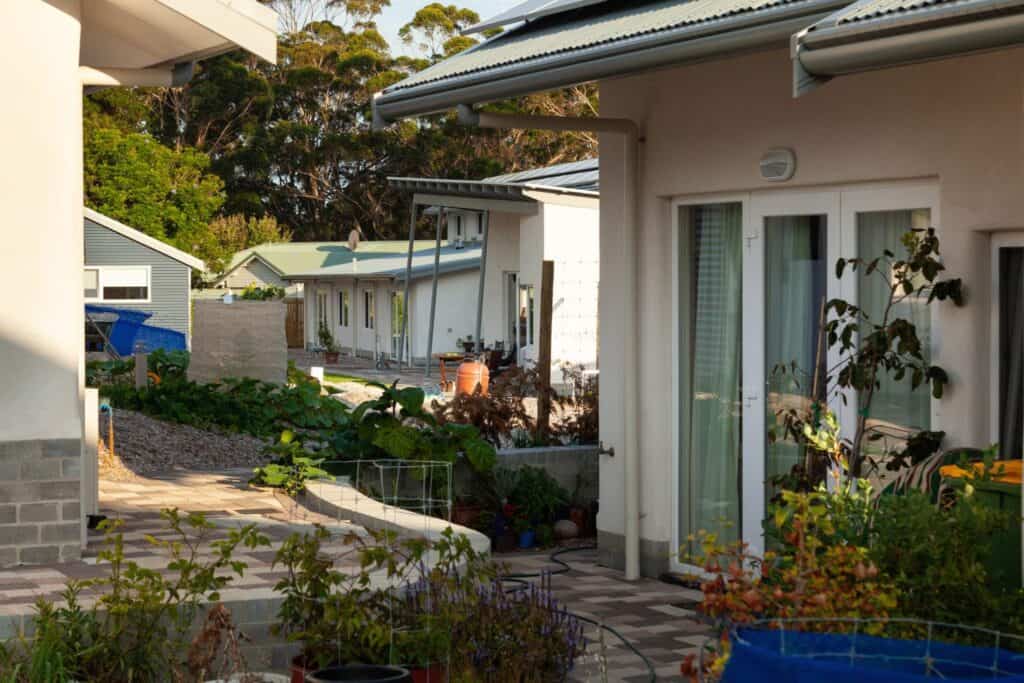
Eco housing village in Denmark with modern studios and garden paths.

DecoHousing Denmark

  • Communities

About the Communities

  • Established
  • English
  • Ecological
  • Town/Small City

Founding year

  • 2017

What we do

DecoHousing Denmark is a small strata-titled cohousing community and ecovillage located in the heart of Denmark, Western Australia. We have 12 compact hempcrete homes, a common house, extensive permaculture gardens and orchards and a communal workshop. We generate nearly all of our own energy from an integrated solar panel and battery system and gather rainwater in two large rainwater tanks. Our gardens and orchards are irrigated with greywater. Our common house is a shared venue for gatherings, communal meals, workshops, meetings, parties, movie nights and the occasional house concert.

Our Vision

We believe in a future built on communal harmony and deep environmental resilience. This visionary project was aimed at providing a new paradigm in affordable, high-density, ecologically sustainable community housing in a rural setting. Our ecovillage is more than just a place to live—it is a conscious commitment to sharing resources, nurturing the earth and fostering a supportive community where daily life is lived in meaningful connection with nature and each other. 

  • Purpose
  • Ecological
  • Social
  • Languages
  • English
  • Community type
  • Cohousing
  • Sustainability practices
  • Ecosystem restoration
  • Renewable energy systems
  • Sustainability education and community engagement
  • Water conservation and management
  • Waste reduction / composting
  • Regenerative agriculture or permaculture
  • Natural / low-impact building
  • Activities
  • Permaculture
  • Ecosystem
  • Temperate Forest

Video

  • Open to visitors
  • Open to volunteers
Total
20

Primary decision-making authority

  • Elected Representatives

A board, council, or committee chosen by members makes decisions on behalf of the community.

Decision-making process

  • Modified Consensus

Generally seek agreement, but have backup methods when consensus isn’t reached.

Governance structure

  • Representative/Democratic

Members elect leaders who make decisions within defined roles.

Conflict resolution approach

Nonviolent conflict resolution

Economic model

  • Membership Fees/Dues Structure

Regular payments for community services and maintenance.

Economic scenarios for this community

  • Members need to pay fees, dues, or similar to live there on a per month or per year basis
  • There is a labor obligation
  • Members typically need to have their own job or other personal source of income to cover their expenses while living in the community?

Vehicle accessibility

  • Most / all people own their own vehicles
  • It would be easy / doable to live in this community without a car
  • There are car sharing opportunities in your community

Shared resources and amenities that are accessible to everyone in the community

Common house (includes guestroom, bathroom, kitchen, laundry and large gathering area), workshop, bike shed, garden shed, gardens, orchards and other outdoor areas

Frequency of communal meals

  • 1-3 times per month

Significant food acquisition practices

  • Growing our own
  • Locally sourced
  • Livestock / Animal Husbandry

Nature of social activity

  • People in the community regularly socialize together

Community activities and engagement

Shared meals, movie nights, busy bees

Local connectedness

  • We have strong relationships with our local community

Friendliness of people and local government

  • It’s a mix

Pet policy

  • No pets are allowed, except in special cases

Predatory animals such as dogs and cats are not allowed. Other pets (as well as support animals) are allowed.

Substance use culture

  • Substance use occurs in peripheral / discrete / only in personal or private spaces

Member support features

  • Transportation assistance available

Level of LGBTQIA+ inclusion

  • Somewhat - we have some LGBTQIA+ members

Gender composition

  • Roughly balanced (no group over 60%)

Age demographics

  • Multi-generational (all ages well represented)

Racial / ethnic demographics

  • Mostly homogeneous (primarily one background)

Socioeconomic and wealth composition

  • Mostly middle class

Diversity representation

  • Chronic illness
  • Mental health conditions

Property status

  • Privately owned

Property owner

  • By a Land Trust, Home Owners Association, or corporation

Ecosystem

  • Temperate Forest

Moderate climate with distinct seasonal changes
Includes deciduous and mixed forest types
Examples: Eastern North American Forests, European Broadleaf Forests

Setting

  • Town/Small City

Smaller municipalities with local services but rural character.

Community type

  • Cohousing

    Private homes with shared common facilities, designed for neighborly
    interaction while maintaining independence.

Community type

  • Entirely or almost entirely built or remodeled with recycled or environmentally friendly materials, and/or using natural building methods
  • Built or remodeled using passive solar design
  • Super-insulated to reduce energy usage
  • Built or remodeled using passive house design

Sustainability approach

  • Ecosystem restoration
  • Renewable energy systems
  • Sustainability education and community engagement
  • Water conservation and management
  • Waste reduction / composting
  • Regenerative agriculture or permaculture
  • Natural / low-impact building

Land practices in our community

  • The community practices permaculture
  • The community is working to build soil using only natural methods

Community type

  • Entirely or almost entirely built or remodeled with recycled or environmentally friendly materials, and/or using natural building methods
  • Built or remodeled using passive solar design
  • Super-insulated to reduce energy usage
  • Built or remodeled using passive house design

Some or all of the buildings are...

  • Entirely or almost entirely built or remodeled with recycled or environmentally friendly materials, and/or using natural building methods
  • Built or remodeled using passive solar design
  • Super-insulated to reduce energy usage
  • Built or remodeled using passive house design

Self-produced energy

  • Over 66%

Energy production methods

Solar panels and batteries

Energy sources used

  • Photovoltaic Solar

Self-produced food

  • Up to 33%

Food production methods

Permaculture gardens and orchards, chickens

Local, organic, or fair trade food

  • Up to 33%

Food systems

  • Community garden
  • Livestock / poultry
  • Shared kitchen or food co-op

Renewable water use

  • 33 - 66%

Water recycle methods

Greywater system

Source of water

  • Rainwater capture and storage for use (barrels, cisterns, etc.)
  • Greywater capture and storage for use

Wastewater management

  • Public sewage

Water conservation practices

  • Greywater reuse
  • Rainwater capture
  • Efficient irrigation (drip, timed, or moisture-based systems)

Waste management practices

  • Composting
  • Public waste collection
  • Recycling program
  • Land area size
    6,000 sqm
  • Land allocated for food production
    3,000 sqm

Guest Book

Written reviews are available for plus members. Click here to upgrade.

DecoHousing Denmark

Promoted Needs and Offers

Offer
  • Events
1 month ago

Italy Ecovillage Tour: September 29 - October 8, 2027

Ecovillage Network logo with sun and moon symbols in purple.
Ecovillage Network logo with green leaves inside a circle.
Ecovillage Network logo with a heart-shaped handshake symbol.
Logo of the Global Ecovillage Network with a stylized flower design.
Logo of the Global Ecovillage Network with interconnected figures.
September 29–October 8, 2026 | Northern Italy Discover the people and places shaping Italy’s ecovillage movement Spend 10 days exploring 7+ intentional communities, ecovillages and cohousing projects across the beautiful landscapes of Northern Italy. Visit communities including Torri Superiore, the Federation of Damanhur, Alpe Pianello, Villaggio Verde, La Casa Rotta, Cohousing Numero Zero and Cohousing Montesole, and meet the people experimenting with more sustainable, cooperative and connected ways of living. Experience a remarkable variety of community models—from a restored 13th-century stone village and world-renowned spiritual communities to rural ecovillages, organic farms and urban cohousing. Learn firsthand about natural building, renewable energy, organic and biodynamic agriculture, water systems, group decision-making and the social tools that help communities thrive. Special workshops introduce approaches such as social permaculture and CLIPS, a community-building framework used across Europe. Along the way, experience the landscapes, food and culture of Northern Italy, traveling through hilltop villages, countryside and historic towns, with even a cross-border visit to Menton on the French Riviera. Through Ecovillage Tours’ partnership with the Italian Ecovillage Network and experienced local guides, the journey offers access and conversations that go far beyond a typical visit. A great fit for: Prospective community members, aspiring community founders, people interested in cohousing, permaculture and sustainable living, and travelers looking for a deeper and more meaningful way to experience Italy. Learn more about this tour: https://www.ecovillagetours.com/italy
September 29, 2027 00:00 – October 8, 2027 23:59
  • Events
7 months ago

From The Ground Up: Ecovillage Design Education

From The Ground Up is a 7-day residential Mini Ecovillage Design Education (EDE) at Entelechy, a 13.5-acre intentional community on Salt Spring Island, British Columbia, Canada. August 9–15, 2026. The course follows the Gaia Education EDE framework, covering four dimensions of sustainability: Ecological – Food systems, natural building, energy and water, appropriate technology. Social – Community governance, communication, conflict resolution, collective decision-making. Economic – Alternative economics, cooperative structures, local currencies, social enterprise. Worldview – The values, beliefs, and cultural frameworks that underlie sustainable community – why people want to live this way, and what has to shift for it to last. The course is facilitated by a graduate of both the full EDE and the Gaia Education Training of Trainers programme. It takes place at a working ecovillage where residents live what they teach. Participants stay on-site for the week in wall tents or camping. Communal meals sourced from local Salt Spring farms and Entelechy’s gardens are included. This course is for anyone interested in designing, joining, or strengthening sustainable communities — whether you’re starting from scratch, already involved in a project, or looking to go deeper than a Permaculture Design Course. Up to 22 spots. Application-based enrollment. Early bird: $950 CAD (before June 15, 2026) Regular: $1,149 CAD Payment plans, group discounts, and work-trade spots available. If interested, we invite you to apply here: https://www.entelechysaltspring.ca/ecovillage-design Salt Spring Island is accessible by BC Ferries from Tsawwassen (Metro Vancouver), Swartz Bay (Greater Victoria), and Crofton (mid-Vancouver Island). From the US Pacific Northwest, either by I-5 and ferry via Vancouver, or by taking Port Angeles ferry to Victoria and the

Update to a Public Profile

  • Log in
  • Go to your profile page
  • Toggle on the "Put me on the People Map"
  • Save your profile

Information

Communities

A residential project: people live here as their primary home.

Organizations

An institution, business, network, or project that isn’t a residence (e.g. a learning center, farm, or network with no one living there full-time).

GeN logo with blue flower motif and plus sign in centre.

Become a + Community Member

  • Find people based on your community tool
  • Post Needs & Offers Listings and Events
  • Access to resources in the Members Library
  • Member badge on your community profile
  • View communities detailed reviews
  • Create Private Groups
I am an official member of this community
Disclaimer
I affirm that my information is accurate and I am authorized to manage this listing
Global Ecovillage Network member banner with FIC circle logo.

Free Plan

Free plan
Free

Intentional Advertising

  • Subtotal

    {{ currencyFormat( pricing_summary.total_amount ) }}

GeN logo with blue flower motif and plus sign in centre.

Become a + Member

  • Find communities based on your profile tool
  • Post Needs & Offers Listings and Events
  • Access to free resources in the Members Library
  • Member badge on your profile
  • View communities detailed reviews
  • Create Private Groups