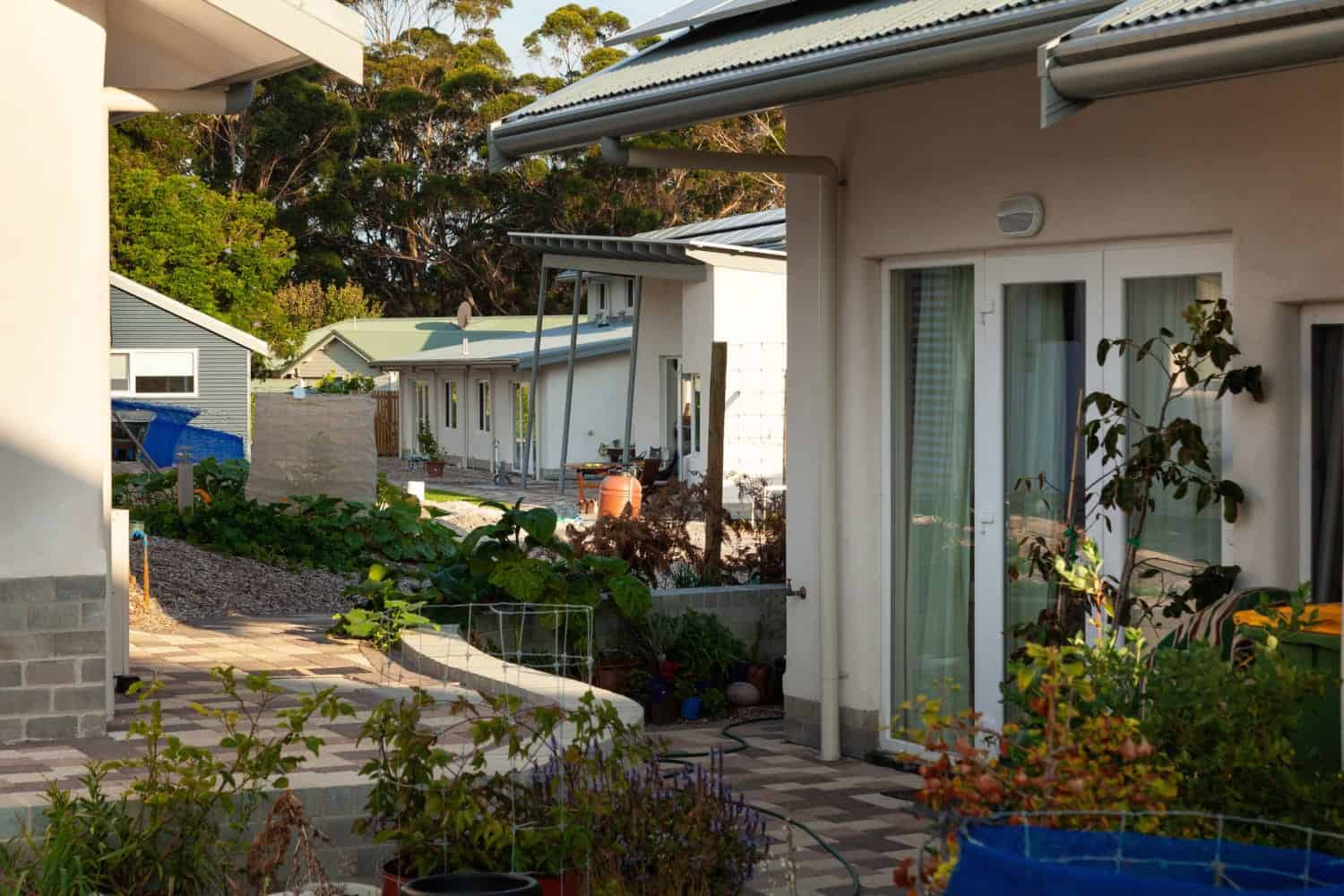
Eco housing village in Denmark with modern studios and garden paths.

DecoHousing Denmark

  • Communities

About the Communities

  • Established
  • English
  • Ecological
  • Town/Small City

Founding year

  • 2017

What we do

DecoHousing Denmark is a small strata-titled cohousing community and ecovillage located in the heart of Denmark, Western Australia. We have 12 compact hempcrete homes, a common house, extensive permaculture gardens and orchards and a communal workshop. We generate nearly all of our own energy from an integrated solar panel and battery system and gather rainwater in two large rainwater tanks. Our gardens and orchards are irrigated with greywater. Our common house is a shared venue for gatherings, communal meals, workshops, meetings, parties, movie nights and the occasional house concert.

Our Vision

We believe in a future built on communal harmony and deep environmental resilience. This visionary project was aimed at providing a new paradigm in affordable, high-density, ecologically sustainable community housing in a rural setting. Our ecovillage is more than just a place to live—it is a conscious commitment to sharing resources, nurturing the earth and fostering a supportive community where daily life is lived in meaningful connection with nature and each other. 

  • Purpose
  • Ecological
  • Social
  • Languages
  • English
  • Community type
  • Cohousing
  • Sustainability practices
  • Ecosystem restoration
  • Renewable energy systems
  • Sustainability education and community engagement
  • Water conservation and management
  • Waste reduction / composting
  • Regenerative agriculture or permaculture
  • Natural / low-impact building
  • Activities
  • Permaculture
  • Ecosystem
  • Temperate Forest

Video

  • Open to visitors
  • Open to volunteers
Total
20

Primary decision-making authority

  • Elected Representatives

A board, council, or committee chosen by members makes decisions on behalf of the community.

Decision-making process

  • Modified Consensus

Generally seek agreement, but have backup methods when consensus isn’t reached.

Governance structure

  • Representative/Democratic

Members elect leaders who make decisions within defined roles.

Conflict resolution approach

Nonviolent conflict resolution

Economic model

  • Membership Fees/Dues Structure

Regular payments for community services and maintenance.

Economic scenarios for this community

  • Members need to pay fees, dues, or similar to live there on a per month or per year basis
  • There is a labor obligation
  • Members typically need to have their own job or other personal source of income to cover their expenses while living in the community?

Vehicle accessibility

  • Most / all people own their own vehicles
  • It would be easy / doable to live in this community without a car
  • There are car sharing opportunities in your community

Shared resources and amenities that are accessible to everyone in the community

Common house (includes guestroom, bathroom, kitchen, laundry and large gathering area), workshop, bike shed, garden shed, gardens, orchards and other outdoor areas

Frequency of communal meals

  • 1-3 times per month

Significant food acquisition practices

  • Growing our own
  • Locally sourced
  • Livestock / Animal Husbandry

Nature of social activity

  • People in the community regularly socialize together

Community activities and engagement

Shared meals, movie nights, busy bees

Local connectedness

  • We have strong relationships with our local community

Friendliness of people and local government

  • It’s a mix

Pet policy

  • No pets are allowed, except in special cases

Predatory animals such as dogs and cats are not allowed. Other pets (as well as support animals) are allowed.

Substance use culture

  • Substance use occurs in peripheral / discrete / only in personal or private spaces

Member support features

  • Transportation assistance available

Level of LGBTQIA+ inclusion

  • Somewhat - we have some LGBTQIA+ members

Gender composition

  • Roughly balanced (no group over 60%)

Age demographics

  • Multi-generational (all ages well represented)

Racial / ethnic demographics

  • Mostly homogeneous (primarily one background)

Socioeconomic and wealth composition

  • Mostly middle class

Diversity representation

  • Chronic illness
  • Mental health conditions

Property status

  • Privately owned

Property owner

  • By a Land Trust, Home Owners Association, or corporation

Ecosystem

  • Temperate Forest

Moderate climate with distinct seasonal changes
Includes deciduous and mixed forest types
Examples: Eastern North American Forests, European Broadleaf Forests

Setting

  • Town/Small City

Smaller municipalities with local services but rural character.

Community type

  • Cohousing

    Private homes with shared common facilities, designed for neighborly
    interaction while maintaining independence.

Community type

  • Entirely or almost entirely built or remodeled with recycled or environmentally friendly materials, and/or using natural building methods
  • Built or remodeled using passive solar design
  • Super-insulated to reduce energy usage
  • Built or remodeled using passive house design

Sustainability approach

  • Ecosystem restoration
  • Renewable energy systems
  • Sustainability education and community engagement
  • Water conservation and management
  • Waste reduction / composting
  • Regenerative agriculture or permaculture
  • Natural / low-impact building

Land practices in our community

  • The community practices permaculture
  • The community is working to build soil using only natural methods

Community type

  • Entirely or almost entirely built or remodeled with recycled or environmentally friendly materials, and/or using natural building methods
  • Built or remodeled using passive solar design
  • Super-insulated to reduce energy usage
  • Built or remodeled using passive house design

Some or all of the buildings are...

  • Entirely or almost entirely built or remodeled with recycled or environmentally friendly materials, and/or using natural building methods
  • Built or remodeled using passive solar design
  • Super-insulated to reduce energy usage
  • Built or remodeled using passive house design

Self-produced energy

  • Over 66%

Energy production methods

Solar panels and batteries

Energy sources used

  • Photovoltaic Solar

Self-produced food

  • Up to 33%

Food production methods

Permaculture gardens and orchards, chickens

Local, organic, or fair trade food

  • Up to 33%

Food systems

  • Community garden
  • Livestock / poultry
  • Shared kitchen or food co-op

Renewable water use

  • 33 - 66%

Water recycle methods

Greywater system

Source of water

  • Rainwater capture and storage for use (barrels, cisterns, etc.)
  • Greywater capture and storage for use

Wastewater management

  • Public sewage

Water conservation practices

  • Greywater reuse
  • Rainwater capture
  • Efficient irrigation (drip, timed, or moisture-based systems)

Waste management practices

  • Composting
  • Public waste collection
  • Recycling program
  • Land area size
    6,000 sqm
  • Land allocated for food production
    3,000 sqm

Guest Book

Written reviews are available for plus members. Click here to upgrade.

DecoHousing Denmark

Promoted Needs and Offers

  • Events
2 months ago

Want to connect with and support sustainable projects in Latin America?

Ecovillage Network logo with sun and moon symbols in purple.
Logo of the Global Ecovillage Network with a stylized flower design.
Logo of the Global Ecovillage Network with interconnected figures.
Want to connect with and support sustainable projects in Latin America? CASA Perú is excited to announce the “ENIS”, Encuentro Nacional de Iniciativas Sostenibles (12/13/09/2026), an upcoming gathering of intentional communities and regenerative initiatives in Oxapampa, Peru’s altitude jungle, 10h from Lima.  It’s a preliminary for the biennially CASA Latina’s meeting, the “ECCO 2027”, Encuentro Continental de Comunidades (27/05-3/06/2027). We expect 180 participants from 15 different nationalities from South America. We also connect with “Raices y Alas”, the NextGEN meeting (11-18/05/2027, Tarapoto, Perú), “only” 16h far from Oxapampa. So you’re very welcome to participate and support both events. We’ll be meeting at San Jorge’s School and surroundings (ecovillage Tierra de Bosques), in Gramazu, 40’ from Oxapampa city, to share workshops, concerts, bio-market and construction. Our main construction goal in 2026 September: a huge kitchen stove and ecological showers/toilets to be ready for you in 2027. Thanks for support ! Those events (both ENIS and ECCO) are titled “Oñets Awathotheñ” : “Ancestral River” in the Yanesha language. We explain why in CASA Latina’s web (when I discover it, I feel SO blessed !). We have the honor to receive the Yanesha Native Community (mainly from Satchopen, 15’ from us) and they’ll led art, music, dance, language, handcrafts, legends and ceremonies. We’ll also open workshops about the 5 dimensions of regeneration with local and international facilitators: Social : participative governance, community-building, egalitarian communities, etc. Ecological: waste management, conscious diet, agro-forestry, vermicompost, etc. Cultural : art-therapy,  Economical: local currencies, digital no speculative money Whole System: dynamics of popular education to understand global interdependencies, presentation of Gaia Union Ecosystem We hope the event will create a stronger regional network in Peru ahead of GEN’s ECCO 2027, which will bring together intentional, native and “campesinas” communities and regenerative leaders from across the world. If you’d like to attend, tickets are available at this link. We’re also seeking volunteers, who can attend at a reduced cost in exchange for help and support from early September. To apply to volunteer, email us. If you’d like to give a talk or offer a workshop, we still have a couple of places available. Please fill up the form (for ENIS 2026). For ECCO 2027, more info coming soon here. Support us through our crowdfunding campaign. Thanks and blessings to all our donators. Your support allow us to build much more than a kitchen. Any donations beyond this goal will support ECCO 2027, to allow the participation of more native leaders from all the peruvian jungle (and further). Hoping to see you in Oxapampa! CASA Peru and CASA Latina Ticket Price for ENIS: S./150 to S/.350 (€40 to €90)* *Our sliding-scale pricing lets you pay what you can. The minimum covers your food and transportation, while higher contributions help subsidize participation for others.
May 28, 2027 09:00 – May 28, 2027 10:00
Need
  • Events
2 weeks ago

Portugal Ecovillage Tour: May 15-24, 2027

Ecovillage Network logo with sun and moon symbols in purple.
Ecovillage Network logo with green leaves inside a circle.
Ecovillage Network logo with a heart-shaped handshake symbol.
Logo of the Global Ecovillage Network with a stylized flower design.
Logo of the Global Ecovillage Network with interconnected figures.
May 15–24, 2027 | Portugal Discover one of Europe’s most vibrant hubs for intentional and regenerative living Spend 10 days exploring more than six inspiring ecovillages and rural initiatives across Portugal, a country that has become a global hotspot for people experimenting with new approaches to community, sustainability and regenerative living. Visit projects including the internationally renowned Tamera peace research village, Traditional Dream Factory, Ananda Kalyani, Spirala Ecological Village, SerVivo and other innovative initiatives working to regenerate both land and community. Meet residents, founders and regenerative leaders and experience a wide variety of approaches to intentional living—from permaculture, regenerative agriculture and ecological restoration to natural building, cooperative economics, alternative social structures and the revitalization of rural villages. Through community visits, hands-on experiences and meaningful conversations, you’ll gain an inside look at both the ecological and human sides of building thriving communities. Along the way, experience Portugal’s beautiful landscapes and culture, from the sun-drenched Alentejo region to the green valleys of Serra da Estrela, while enjoying local food and the connections that naturally develop when traveling with a small group. A great fit for: Prospective community members, aspiring community founders, people interested in regenerative and sustainable living, and travelers who want to experience Portugal through the lens of community, connection and ecological regeneration. Learn more about this tour: https://www.ecovillagetours.com/portugal
May 15, 2027 00:00 – May 24, 2027 23:59

Update to a Public Profile

  • Log in
  • Go to your profile page
  • Toggle on the "Put me on the People Map"
  • Save your profile

Information

Communities

A residential project: people live here as their primary home.

Organizations

An institution, business, network, or project that isn’t a residence (e.g. a learning center, farm, or network with no one living there full-time).

GeN logo with blue flower motif and plus sign in centre.

Become a + Community Member

  • Find people based on your community tool
  • Post Needs & Offers Listings and Events
  • Access to resources in the Members Library
  • Member badge on your community profile
  • View communities detailed reviews
  • Create Private Groups
I am an official member of this community
Disclaimer
I affirm that my information is accurate and I am authorized to manage this listing

Free Plan

Free plan
Free

Intentional Advertising

  • Subtotal

    {{ currencyFormat( pricing_summary.total_amount ) }}

GeN logo with blue flower motif and plus sign in centre.

Become a + Member

  • Find communities based on your profile tool
  • Post Needs & Offers Listings and Events
  • Access to free resources in the Members Library
  • Member badge on your profile
  • View communities detailed reviews
  • Create Private Groups