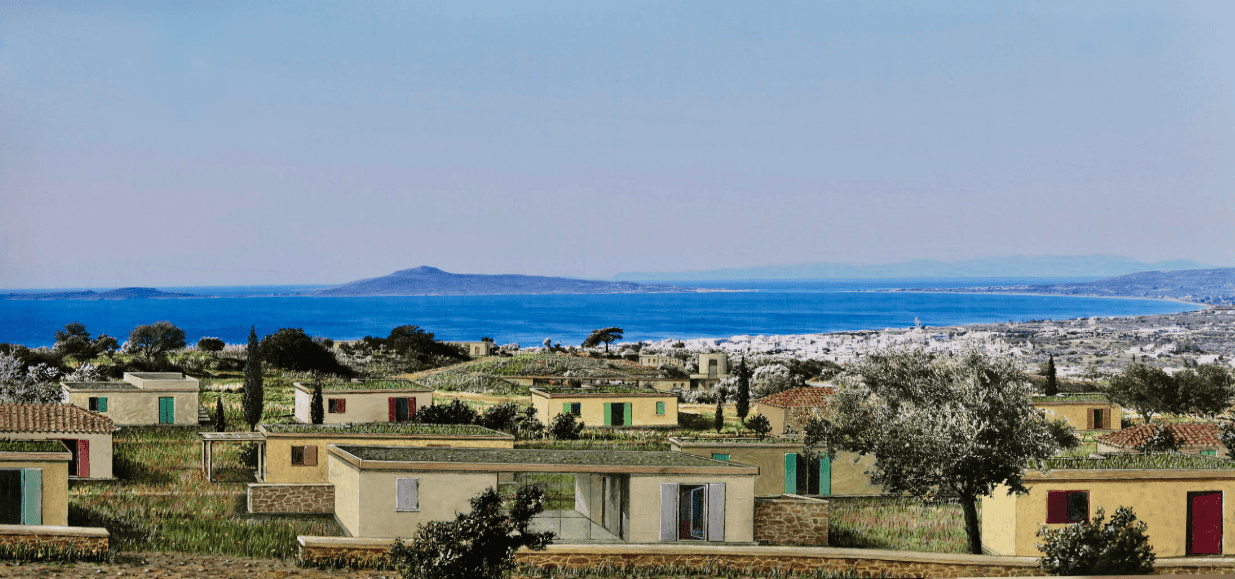
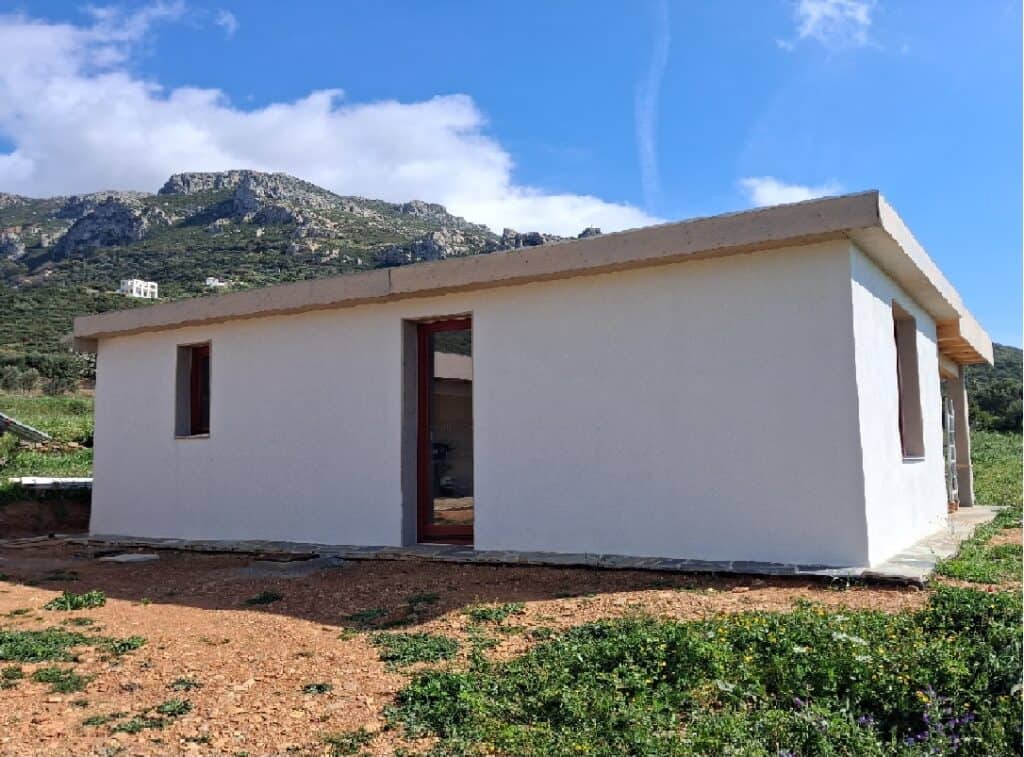
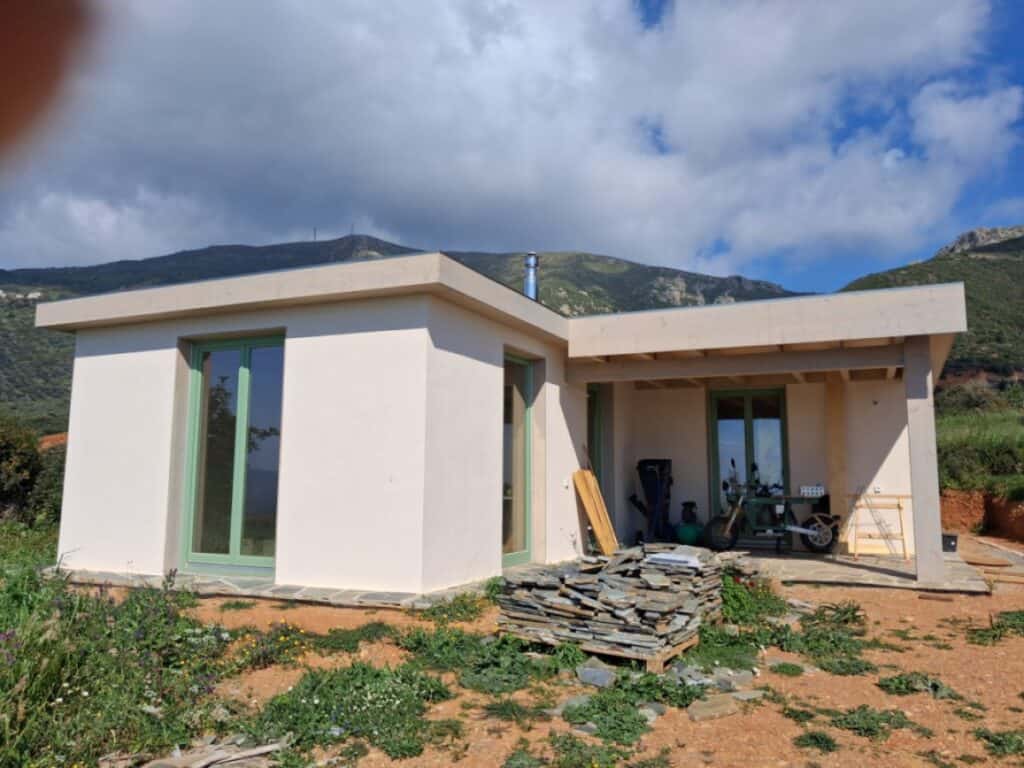
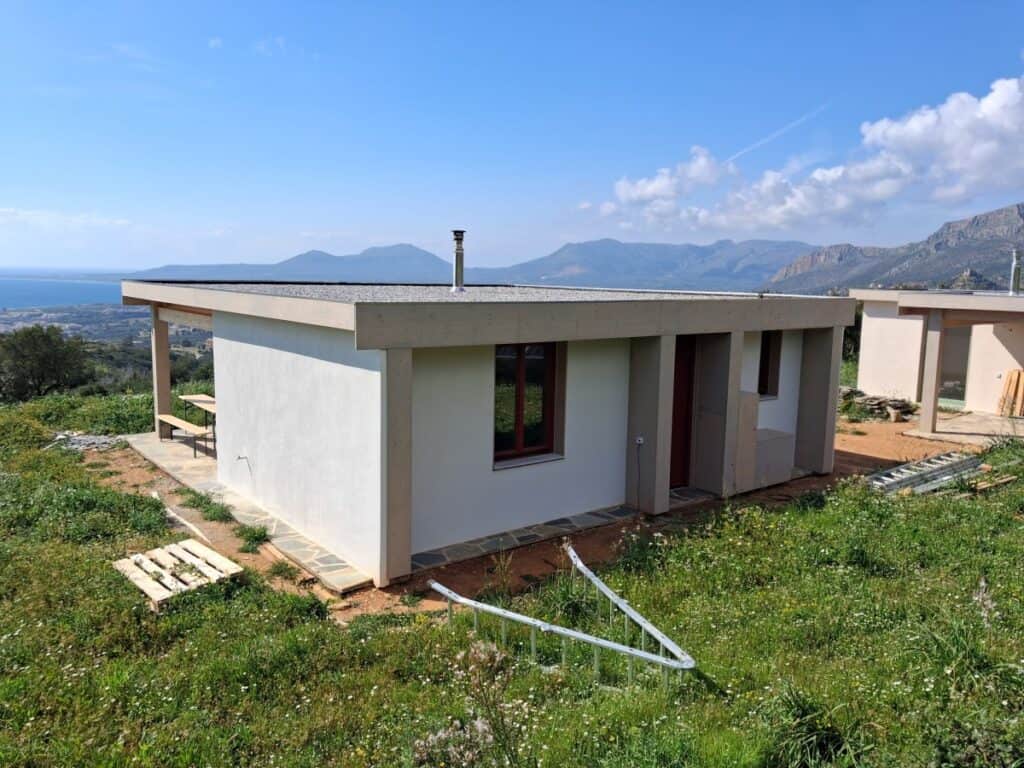
Ecovillage community houses with the sea in the background.

Ecoliving Paradeisi

  • Communities

About the Communities

  • Forming
  • English
  • Ecological
  • Town/Small City

What we do

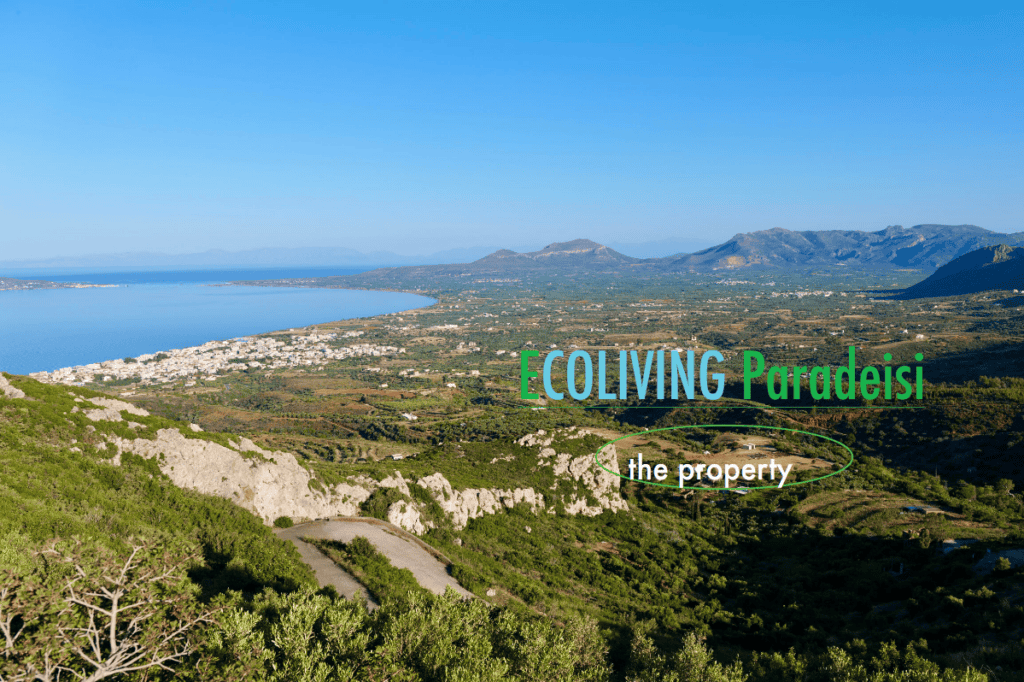
Ecoliving Paradeisi is a cohousing / ecovillage forming near the lively town Neapoli Voion at the Southern edge of the European continent. Two small wooden modular houses with compost toilets have been built as the first of 14 residential houses + a common house and five guest houses, which are the scope of the project. On the wide hills above the small port town of Neapoli, 3 kilometers away, there is a fantastically located 1.2 hectare building plot with magnificent sea views and magical sunsets. The ECOLIVING PARADEISI is being built there, named after the sparsely populated Paradeisi region. The easy-to-build area is divided into plots, which will be designed with modular wooden houses, preferably Tiny houses, with sustainable materials like clay, hemp and other ecological materials.
Of course we use alternative energy concepts.

Our Vision

We take responsibility and care for ourselves and our environment. It’s time we implement our visions for new living spaces and not just talk about them! With the Ecoliving Paradeisi project we would like to make a contribution to this in hope that the right people will come together to make this dream come true.

  • Purpose
  • Ecological
  • 4 Areas of Regeneration
  • Economical
  • Home-sharing
  • Social
  • Languages
  • English
  • Danish
  • English
  • French
  • German
  • Greek
  • Spanish
  • Community type
  • Cohousing
  • Tiny Houses
  • Ecovillage
  • Sustainability practices
  • Ecosystem restoration
  • Renewable energy systems
  • Sustainability education and community engagement
  • Water conservation and management
  • Waste reduction / composting
  • Regenerative agriculture or permaculture
  • Permaculture design
  • Natural / low-impact building
  • Carbon footprint reduction tracking or goals
  • Ecosystem
  • Mediterranean

Gallery

  • 3 Total members
  • Open to new members
  • Open to visitors
  • Open to volunteers

How to join

We offer trial stays in one of the houses and take it from there. New members must be accepted by the existing ones.
The price for plot and house including shares of common areas and buildings begin at 150.000 € for the smallest tiny house.

Basic expectations or agreements for members

Ecological consciousness, good neighbourly attitude and willingness to contribute to the community.

Primary decision-making authority

  • All Community Members Together

The whole membership decides collectively.

Decision-making process

  • Modified Consensus

Generally seek agreement, but have backup methods when consensus isn’t reached.

Governance structure

  • Collaborative/Horizontal

Power and responsibility are shared relatively equally among members.

Conflict resolution approach

Non violent with mediator.

Economic model

  • Independent Finances

Members maintain separate personal finances with minimal sharing.

Economic scenarios for this community

  • There is a one-time fee, investment, or share purchase to join the community separate from accessing housing
  • There is a labor obligation

Additional economic information

The common area and buildings (common house and guest buildings) will be purchased as soon as the 14 residential building plots are financed unless funding is obtained earlier.

Vehicle accessibility

  • Most / all people own their own vehicles
  • It would be easy / doable to live in this community without a car
  • There are restrictions on personal vehicles being owned or kept on the property

Shared resources and amenities that are accessible to everyone in the community

Carpark outside the village is planned /expected. Car sharing is planned /  expected.

Frequency of communal meals

  • About once a week

Significant food acquisition practices

  • Growing our own
  • Locally sourced
  • Wildcrafting / Foraging
  • Livestock / Animal Husbandry

Nature of social activity

  • People in the community regularly socialize together

Community activities and engagement

Yoga, volleyball, table tennis, football, boccia, batminton.
Swimming, hiking, bicykling, barbecues, picknicks.
Dancing, singing, movies, music playing and listening, playing analog (board)games.
Bioregional activities, regenerative farming support.

Local connectedness

  • We try to engage with our local community

Friendliness of people and local government

  • There is a moderate amount of connection and collaboration between people and local government

Pet policy

  • Pets are allowed, with special approval or according to policy

Pet policy to be developed according to demand.

Substance use culture

  • Substance use is prohibited in the community

Practiced relationship models

  • Monogamy

Member support features

  • Onsite or nearby medical facilities
  • Spiritual Practices
  • Holistic health approaches
  • Meditation
  • Mindfulness

DEI and anti-oppression training

  • Yes, some individuals

Internal course at a large engineering company.

Internal and external practices

  • Engages with local politics
  • Supports or creates land reparation/reclamation projects

Internal course at a large engineering company.

Level of LGBTQIA+ inclusion

  • Not particularly - mostly heterosexual members

Gender composition

  • Majority cis (over 60%)

Age demographics

  • Primarily mature adults (over 40)

Racial / ethnic demographics

  • Moderately diverse (3-4 different backgrounds)

Socioeconomic and wealth composition

  • Moderately diverse (some economic variety)

Property status

  • Privately owned

Property owner

  • By several individuals through an LLC or a Tenancy In Common agreement

Ecosystem

  • Mediterranean

Characterized by wet winters and dry summers
Specific flora and fauna adapted to this unique climate
Found around Mediterranean Basin, parts of California, Chile

Setting

  • Town/Small City

Smaller municipalities with local services but rural character.

Community type

  • Entirely or almost entirely built or remodeled with recycled or environmentally friendly materials, and/or using natural building methods
  • Built or remodeled using passive solar design
  • Super-insulated to reduce energy usage

Sustainability approach

  • Ecosystem restoration
  • Renewable energy systems
  • Sustainability education and community engagement
  • Water conservation and management
  • Waste reduction / composting
  • Regenerative agriculture or permaculture
  • Permaculture design
  • Natural / low-impact building
  • Carbon footprint reduction tracking or goals

Land practices in our community

  • The community practices permaculture
  • The community is working to remove invasive plants and grow only indigenous plants
  • The community is working to build soil using only natural methods
  • The community is working to restore the natural courses of water through the land

Community type

  • Entirely or almost entirely built or remodeled with recycled or environmentally friendly materials, and/or using natural building methods
  • Built or remodeled using passive solar design
  • Super-insulated to reduce energy usage

Some or all of the buildings are...

  • Entirely or almost entirely built or remodeled with recycled or environmentally friendly materials, and/or using natural building methods
  • Built or remodeled using passive solar design
  • Super-insulated to reduce energy usage

Self-produced energy

  • Over 66%

Energy production methods

PV

Energy sources used

  • Photovoltaic Solar
  • Biomass (from wood or other organic materials)

Self-produced food

  • Up to 33%

Food production methods

Garden, food forest, raised garden beds

Local, organic, or fair trade food

  • Over 66%

Food purchase methods

Farmers market, local grocers

Food systems

  • Community garden
  • Food forest
  • Livestock / poultry
  • Seed saving / exchange
  • Shared kitchen or food co-op

Renewable water use

  • Up to 33%

Water recycle methods

Roof water, surface water and grey water are collected for irrigation.

Source of water

  • Spring water
  • Well water
  • Rainwater capture and storage for use (barrels, cisterns, etc.)
  • Public water supply
  • Greywater capture and storage for use

Wastewater management

  • Wastewater pond
  • Biodigester

Water conservation practices

  • Greywater reuse
  • Rainwater capture
  • Efficient irrigation (drip, timed, or moisture-based systems)
  • Composting toilets

Waste management practices

  • Composting
  • Public waste collection
  • Reuse or repair systems
  • Land area size
    1,2
  • Land allocated for food production
    0,5
  • Land used for biodiversity enhancement
    0,4
  • Land used for tree planting
    0,5

Guest Book

Written reviews are available for plus members. Click here to upgrade.

Ecoliving Paradeisi

Promoted Needs and Offers

Need
  • Events
3 months ago

Want to connect with and support sustainable projects in Latin America?

Ecovillage Network logo with sun and moon symbols in purple.
Logo of the Global Ecovillage Network with a stylized flower design.
Logo of the Global Ecovillage Network with interconnected figures.
Want to connect with and support sustainable projects in Latin America? CASA Perú is excited to announce the “ENIS”, Encuentro Nacional de Iniciativas Sostenibles (12/13/09/2026), an upcoming gathering of intentional communities and regenerative initiatives in Oxapampa, Peru’s altitude jungle, 10h from Lima.  It’s a preliminary for the biennially CASA Latina’s meeting, the “ECCO 2027”, Encuentro Continental de Comunidades (27/05-3/06/2027). We expect 180 participants from 15 different nationalities from South America. We also connect with “Raices y Alas”, the NextGEN meeting (11-18/05/2027, Tarapoto, Perú), “only” 16h far from Oxapampa. So you’re very welcome to participate and support both events. We’ll be meeting at San Jorge’s School and surroundings (ecovillage Tierra de Bosques), in Gramazu, 40’ from Oxapampa city, to share workshops, concerts, bio-market and construction. Our main construction goal in 2026 September: a huge kitchen stove and ecological showers/toilets to be ready for you in 2027. Thanks for support ! Those events (both ENIS and ECCO) are titled “Oñets Awathotheñ” : “Ancestral River” in the Yanesha language. We explain why in CASA Latina’s web (when I discover it, I feel SO blessed !). We have the honor to receive the Yanesha Native Community (mainly from Satchopen, 15’ from us) and they’ll led art, music, dance, language, handcrafts, legends and ceremonies. We’ll also open workshops about the 5 dimensions of regeneration with local and international facilitators: Social : participative governance, community-building, egalitarian communities, etc. Ecological: waste management, conscious diet, agro-forestry, vermicompost, etc. Cultural : art-therapy,  Economical: local currencies, digital no speculative money Whole System: dynamics of popular education to understand global interdependencies, presentation of Gaia Union Ecosystem We hope the event will create a stronger regional network in Peru ahead of GEN’s ECCO 2027, which will bring together intentional, native and “campesinas” communities and regenerative leaders from across the world. If you’d like to attend, tickets are available at this link. We’re also seeking volunteers, who can attend at a reduced cost in exchange for help and support from early September. To apply to volunteer, email us. If you’d like to give a talk or offer a workshop, we still have a couple of places available. Please fill up the form (for ENIS 2026). For ECCO 2027, more info coming soon here. Support us through our crowdfunding campaign. Thanks and blessings to all our donators. Your support allow us to build much more than a kitchen. Any donations beyond this goal will support ECCO 2027, to allow the participation of more native leaders from all the peruvian jungle (and further). Hoping to see you in Oxapampa! CASA Peru and CASA Latina Ticket Price for ENIS: S./150 to S/.350 (€40 to €90)* *Our sliding-scale pricing lets you pay what you can. The minimum covers your food and transportation, while higher contributions help subsidize participation for others.
May 28, 2027 09:00 – May 28, 2027 10:00
  • Events
7 months ago

From The Ground Up: Ecovillage Design Education

From The Ground Up is a 7-day residential Mini Ecovillage Design Education (EDE) at Entelechy, a 13.5-acre intentional community on Salt Spring Island, British Columbia, Canada. August 9–15, 2026. The course follows the Gaia Education EDE framework, covering four dimensions of sustainability: Ecological – Food systems, natural building, energy and water, appropriate technology. Social – Community governance, communication, conflict resolution, collective decision-making. Economic – Alternative economics, cooperative structures, local currencies, social enterprise. Worldview – The values, beliefs, and cultural frameworks that underlie sustainable community – why people want to live this way, and what has to shift for it to last. The course is facilitated by a graduate of both the full EDE and the Gaia Education Training of Trainers programme. It takes place at a working ecovillage where residents live what they teach. Participants stay on-site for the week in wall tents or camping. Communal meals sourced from local Salt Spring farms and Entelechy’s gardens are included. This course is for anyone interested in designing, joining, or strengthening sustainable communities — whether you’re starting from scratch, already involved in a project, or looking to go deeper than a Permaculture Design Course. Up to 22 spots. Application-based enrollment. Early bird: $950 CAD (before June 15, 2026) Regular: $1,149 CAD Payment plans, group discounts, and work-trade spots available. If interested, we invite you to apply here: https://www.entelechysaltspring.ca/ecovillage-design Salt Spring Island is accessible by BC Ferries from Tsawwassen (Metro Vancouver), Swartz Bay (Greater Victoria), and Crofton (mid-Vancouver Island). From the US Pacific Northwest, either by I-5 and ferry via Vancouver, or by taking Port Angeles ferry to Victoria and the

Update to a Public Profile

  • Log in
  • Go to your profile page
  • Toggle on the "Put me on the People Map"
  • Save your profile

Information

Communities

A residential project: people live here as their primary home.

Organizations

An institution, business, network, or project that isn’t a residence (e.g. a learning center, farm, or network with no one living there full-time).

GeN logo with blue flower motif and plus sign in centre.

Become a + Community Member

  • Find people based on your community tool
  • Post Needs & Offers Listings and Events
  • Access to resources in the Members Library
  • Member badge on your community profile
  • View communities detailed reviews
  • Create Private Groups
I am an official member of this community
Disclaimer
I affirm that my information is accurate and I am authorized to manage this listing
Global Ecovillage Network member banner with FIC circle logo.

Free Plan

Free plan
Free

Intentional Advertising

  • Subtotal

    {{ currencyFormat( pricing_summary.total_amount ) }}

GeN logo with blue flower motif and plus sign in centre.

Become a + Member

  • Find communities based on your profile tool
  • Post Needs & Offers Listings and Events
  • Access to free resources in the Members Library
  • Member badge on your profile
  • View communities detailed reviews
  • Create Private Groups