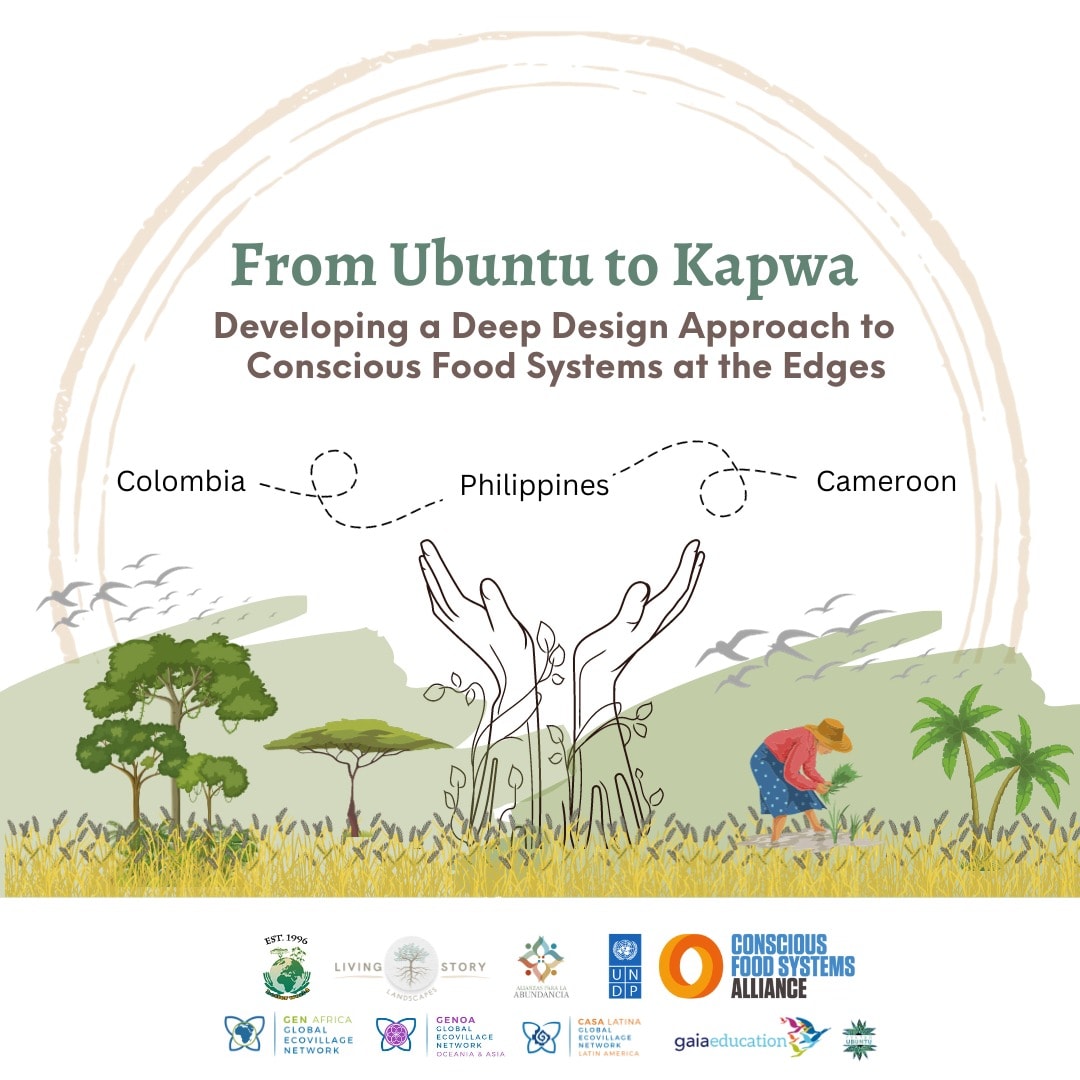
From Ubuntu to Kapwa, Developing a Deep Design Approach to Conscious Food Systems at the Edges” is an initiative from Better World Cameroon in Cameroon, Living Story Landscapes in the Philippines, and Alianzas para la Abundancia in Colombia.
WHAT
The ‘From Ubuntu to Kapwa’ project, a South to South collaboration engaging regenerative food systems in Africa, Asia-Pacific, and Latin America is an action research to inclusively design a new framework and methodology for whole systems change in places where climate and conflict vulnerability co-exist.
Developing a “deep design approach from the edges,” drawing from its indigenous and local community knowledge, wisdom, systems and practices, the project envisions thriving conscious food systems that address socio-political, economic, and ecological challenges of climate and conflict vulnerable landscapes.
Employing conscious and transformative approaches to food production, consumption & trade are embedded in indigenous ways of knowing, relating and being is crucial to making the transition to regenerative food systems
WHY
Globally, there are over 370 million Indigenous Peoples and communities who live on about 24% of land worldwide, with 80% of the world’s biodiversity. There is a significant risk of a major global food crisis impacting 48 countries and killing >1 million people later this year, especially pregnant mothers and babies, and impoverishing 100 million. Being the world’s most vulnerable to climatic changes, ‘Global South’ nations are disproportionately affected. For the first time since 1816, global food production may well reach the point where famines can’t be relieved for adults.
We aim to bring out the important role of the cultural / worldview dimension of the Ecovillage Design Mandala – a design framework developed by the Global Ecovillage Network and Gaia Education. This Mandala is used and applied in Ecovillage Development Programs applied in policy building, climate adaptation, and economic development. The potential to localise its approach with value indigenous and local wisdom has not yet been harnessed.
HOW
It is in the spirit of “Ubuntu” and “Kapwa,” the African, African-Colombian, and Filipino worldview of the shared self that this action – research will be developed and led by members of the Global Ecovillage Network and Gaia Education using the ecovillage design education (EDE) model as a global learning framework and methodology used by an estimated 6000 organisations and ecovillages, projects, and its partners around the world.
“Culture” is currently considered a separate dimension creating a disconnect to the mental models that shape events that take place. Thus, there is a need for a deep design with its integration in social, economic, and ecological dimensions. Therefore we aim to develop valuation indicators and metrics to validate our framework and methodology drawn from the wisdom traditions through:
Sustainable Landscapes
in Cameroon through rites of passage processes known as the spirit of Ndanifor in the production of High Value Agricultural Products;
in the Philippines integrated in permaculture projects in climate and conflict areas for food security
In Colombia, as core pillar in the gatherings and projects through ceremonies
Food Systems Policy and Pathways
in the Philippines as a scaling lab for long term disaster recovery and mitigation
in Cameroon through a joint task force (tradition and government), and ICLEI partnership with 7 other African governments with NDC contributions (NDC)
Supply Chain Transformation
In the Philippines through the integration of a biocultural heritage documentation as a participatory value chain tool with the Department of Trade and Industry.
In Cameroon through conscious cooperative values for social enterprises on national cocoa and coffee
In Colombia with the development of local markets and taking advantage of the community ecotourism
This would be drawing out the following approaches and others that may emerge:
Indigenous and spiritual traditions that embody the traditional ecological knowledge (TEK) and cultural wisdom such as the “Rite of passage” in Africa, the “Tree ordination” in Southeast Asia, “Mother Earth recognition and give back ceremonies” and “Spiritual payment or Pagamentos” in Latin America, food offerings and blessings in multiple traditions, among others.
Traditional/indigenous arts and rituals which embody the eco-centric worldview, deepen nature connection and deep sense of interconnectedness.
Mindfulness-based process including contemplative practices, meditation, journaling, collective witnessing and self-cultivation.
Awareness based facilitation and hosting practices such as Appreciative Inquiry, The Circle Way, Theory U, deep listening etc.
GOALS & JOURNEY OF UBUNTU TO KAPWA
In six months, our goal is the development of an enhanced ecovillage design framework and curriculum for conscious food systems integrating the indigenous and local wisdom and practices from the Global South.
We will follow a 65 stage learning journey inspired by indigenous research methods:
LISTENING: Responding to the call and gathering where the project is launched
HONOURING: Acknowledging and recognizing existing practices that integrate and apply indigenous and local wisdom to food systems
DREAMING: Developing a deep design framework and methodology
OFFERING: Sharing and testing the deep design framework and methodology
LEARNING: Harvesting inputs and revising the framework, methodology, and design curriculum
CELEBRATING: Looking back at our journey with gratitude and share it with others
We aim to:
work with 45 key food system stakeholders in 3 countries to document knowledge and practices on conscious approaches to food systems transformation through indigenous and local wisdom to develop:
an exhibition of stories through art, media, and ritual,
3 case studies from 3 countries
a deep design framework and methodology within the ecovillage design curriculum in designing regenerative food systems
test these practices with 10 organizations or initiatives in 3 regions as new learning platforms and materials for other countries of the regions involved and come up with
an enhanced ecovillage design curriculum and training design that could be replicated across CoFSA partner hubs
a guidance document with reflections and recommendations from the workshop participants
additional case studies showcasing implementation of the approach after the project.
Ultimately, we aim to amplify the role of “culture and worldview” from indigenous and local wisdom applied to the following design dimensions enabling
Social – inner capacities that influence leadership, conflict resolution, power dynamics and decision making, and mental health
Economic – inner capacities that heal and re-assess true value and capital that would meet economic needs by
Ecological – inner capacities that harness nature based solutions from a place of cooperation and kinship with nature
WHERE THE PROJECT IS BEING PILOTED
The project will be piloted in 3 projects in 3 countries (Cameroon, Philippines, and Colombia) where it aims to involve frontline food system actors such as farmers and fisherfolk, those who work with them directly or help enable mechanisms for addressing their challenges such as civil society organisations, local governments, and businesses. We would be engaging their indigenous and/or local wisdom bearers and scholars in collaboration with local research institutions and/or universities to help in knowledge management particularly the documentation and evaluation of the process and outputs.
In Africa, in Cameroon through the work of Better World Cameroon where political insecurities and climatic changes have led to food aid-dependent communities and widened the social gap (GEN Africa)
In Asia, in the Philippines through the work of Living Story Landscapes in collaboration with Green Releaf Initiative and its partners with ongoing loss and damage from its climate vulnerability and continued peacebuilding efforts after a newly established autonomous government born out of rebellion while recovering from ISIL affiliated attacks (GENOA)
In Latin America, In Colombia through the work of Alianzas para la Abundancia and its Center for Training and Experimentation of sustainability “Ubuntu” in peacebuilding efforts and climate change impacts. (CASA Latina)
Presenting Proven Climate Solutions: 30 Years of Regenerative Living The Global Ecovillage Network (GEN) brings nearly three decades of proven climate so…
By Cynthia Tina, founder of Ecovillage Tours and author of Intentional Community: How to Choose Community Living for Better Housing, Health, and Happiness On…
There are moments when a dream stops being something you carry alone and becomes something the world can finally hold. This is one of those moments. The laun…
The flag defines if the Security Firewall was passed.
Session
spbc_cookies_test
Cookie to test cookies so we know that everything working properly
Session
ct_sfw_
Group of cookies used for our SpamFireWall technology.
Session
ct_
Group of cookies used for storing dynamic variables from browser
Session
apbct_
Group of cookies which are set from backend and contain information about the current user
Session
apbct_cookies_test
Сookie to validate other cookies, so they can’t be spoofed.
Session
ct_timezone
Used in order to detect spam and improve the website's security.
Session
ct_ps_timestamp
Used in order to detect spam and improve the website's security. Does not store visitor specific data.
session
ct_pointer_data
Used in order to detect spam and improve the website's security. Does not store visitor specific data.
session
ct_has_scrolled
This cookie is used to distinguish between humans and bots.
session
ct_fkp_timestamp
Used in order to detect spam and improve the website's security. Does not store visitor specific data.
session
ct_check_js
Used in order to detect spam and improve the website's security.
session
apbct_antibot
This cookie is used to distinguish between humans and bots. This is beneficial for the website, in order to make valid reports on the use of their website.
session
spbc_2fa_passed
Dashboard. Flag defines if Two-Factor Authentication was passed.
Session
spbc_log_id
Dashboard. User identification.
Session
spbc_timer
Dashboard. Time spent on the page.
Session
These cookies are needed for adding comments on this website.
Name
Description
Duration
comment_author_url
Used to track the user across multiple sessions.
Session
comment_author_email
Used to track the user across multiple sessions.
Session
comment_author
Used to track the user across multiple sessions.
Session
These cookies are used for managing login functionality on this website.
Name
Description
Duration
wordpress_test_cookie
Used to determine if cookies are enabled.
Session
wordpress_sec
Used to track the user across multiple sessions.
15 days
wordpress_logged_in
Used to store logged-in users.
Persistent
Statistics cookies collect information anonymously. This information helps us understand how visitors use our website.
Google Analytics is a powerful tool that tracks and analyzes website traffic for informed marketing decisions.
Used to distinguish new sessions and visits. This cookie is set when the GA.js javascript library is loaded and there is no existing __utmb cookie. The cookie is updated every time data is sent to the Google Analytics server.
30 minutes after last activity
__utmc
Used only with old Urchin versions of Google Analytics and not with GA.js. Was used to distinguish between new sessions and visits at the end of a session.
End of session (browser)
__utmz
Contains information about the traffic source or campaign that directed user to the website. The cookie is set when the GA.js javascript is loaded and updated when data is sent to the Google Anaytics server
6 months after last activity
__utmv
Contains custom information set by the web developer via the _setCustomVar method in Google Analytics. This cookie is updated every time new data is sent to the Google Analytics server.
2 years after last activity
__utmx
Used to determine whether a user is included in an A / B or Multivariate test.
18 months
_ga
ID used to identify users
2 years
_gali
Used by Google Analytics to determine which links on a page are being clicked
30 seconds
_ga_
ID used to identify users
2 years
_gid
ID used to identify users for 24 hours after last activity
24 hours
_gat
Used to monitor number of Google Analytics server requests when using Google Tag Manager
1 minute
_gac_
Contains information related to marketing campaigns of the user. These are shared with Google AdWords / Google Ads when the Google Ads and Google Analytics accounts are linked together.
90 days
__utma
ID used to identify users and sessions
2 years after last activity
__utmt
Used to monitor number of Google Analytics server requests