

The People’s Coast Ecovillage Network was founded as a result of two ecovillage and permaculture design courses in 2014 and 2015 that brought together villages in Gambia, Senegal, and Guinea Bissau, inspiring them to create a bio-regional approach to eco-development.
The People’s Coast Ecovillage Network was founded as an outcome of two ecovillage design education courses (EDEs) and a permaculture design education course (PDC) that were held in The Gambia in 2014 and 2015. In total, 78 people completed the courses, which included some 65 local residents of the 11 participating local villages.
A scene from the certification, attended by 55 EDE/PDC alumni and 100+ visitors. The “EDE choir” is about to sing to the assembled company.
The EDEs brought together participants from 8 Gambian villages and three villages in southern Senegal, along with participants from Guinea Bissau. This transnational action was a requirement of the EDE funding organisation and has led to a bioregional approach to ecovillage development.
An important follow-up from the EDEs is the monthly meetings that regularly bring together at least 40 of the EDE participants. On an alternating basis, the monthly meetings are held at either at the Sandele Eco-Retreat and Learning Centre, the hub of the ecovillage movement, or at a village from The People’s Coast Ecovillage Network – including the Senegalese villages. This has proved to be a very important feature of The People’s Coast’s development. The meetings follow the EDE pattern of: early morning practises, tuning in, community sensitisation, formal business, games, films, fun and laughter.
A number of people have returned to their villages from the urban areas and 12 people have found employment, directly or indirectly, with Sandele or the Sandele Foundation (the NGO set up by Sandele to support ecovillage and other developments in The People’s Coast area).
During the EDEs and the PDC, some 15 project groups were formed, several of which have progressed into being small business start-ups. The 2016 year has been declared “the Year of the Forest” and plant pot-making from recycled cement bags, tree seed collection days, and a rainy season planting event are planned. Awareness raising in the local schools is about to start and “greening the schools” will begin later this year.
Publicity and communication is important and a Media Team has emerged from among the participants. Four people are employed, through the generosity of the Heidehof Foundation, and 7 short films have already been shot. A website, as well as YouTube, Facebook, and Twitter accounts have been set up.
EDE participants have been internationally active and mobile. About 20 people have attended courses, conferences and events abroad and returned to educate the local network on their findings. This includes the 10 people who were at the Global Ecovillage Network (GEN) Africa Summit in Dakar, Senegal (December 2015).
One person will be joining the Mandela Washington Fellowship for Young African Leaders in June 2016. He will undertake a civic leadership course for 6 weeks at Kansas State University followed by the president’s three-day programme and a six-week internship. This would not have happened without the EDE.
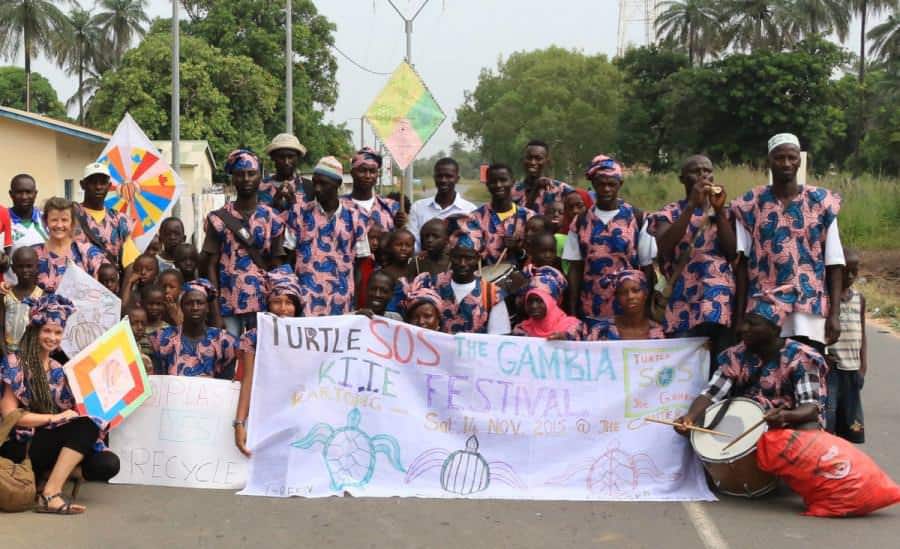
In 2014, a marine turtle conservation programme was established. Thirty-five of the EDE participants have registered as volunteer beach patrollers and two of them are employed, thanks to the support of the Heidehof Foundation. Pictured: A group of turtle conservation volunteers on an awareness raising mission.
Keep the conversation going with these pieces
There are no available blogs
Subscribe to our newsletter for fresh stories and ecovillage updates delivered to your inbox.
Get Plus and connect deeper with direct messaging, vetted content, private groups, and more.
We use cookies to improve your experience on our site. By using our site, you consent to cookies.
Manage your cookie preferences below:
Essential cookies enable basic functions and are necessary for the proper function of the website.
CleanTalk offers effective spam protection and website security solutions to enhance user experience.
Service URL: cleantalk.org (opens in a new window)
These cookies are needed for adding comments on this website.
These cookies are used for managing login functionality on this website.
Statistics cookies collect information anonymously. This information helps us understand how visitors use our website.
Google Analytics is a powerful tool that tracks and analyzes website traffic for informed marketing decisions.
Service URL: policies.google.com (opens in a new window)
A residential project: people live here as their primary home.
An institution, business, network, or project that isn’t a residence (e.g. a learning center, farm, or network with no one living there full-time).

{{ item.label }}
{{ item.value ? item.value : currencyFormat( item.amount ) }}
Subtotal
{{ currencyFormat( pricing_summary.total_amount ) }}
There are no results matching your search

