


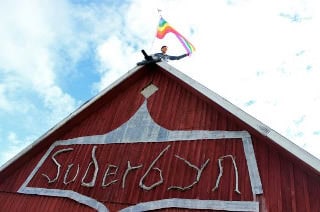
Sustainable development is not only about recycling or having an awareness of climate change. It is a change in our way of thinking and action in relation with nature, the world and humankind; grounded in the belief that the physical, social and intellectual worlds are interconnected. Based on this conviction, the project “Traditional knowledge for a modern and sustainable lifestyle” was developed. GEN Ambassador Jesús Pachecho Justo from Suderbyn Ecovillage, Sweden reports.
The project, was developed by three different Gotlandic organisations:
The project was organised in three different parts. The first was the initial seminar where preconceptions and initial opinions were discussed. The participants considered the role of handicraft in contemporary society, and its ecological advantages and drawbacks.
Two different materials were chosen for further study in the courses that followed. The decision was made upon consideration of what was the most locally accessible and abundant source material. Our conclusion was to look closer at wood and wool. Working with wood has a long tradition in Sweden – both in craft and traditional building. So the agreement to choose this material was unanimous.
The second material, wool – and specifically Gotlandic wool – is popular for its high quality and heritage. In spite of this, only 30 % of wool production on the island is used and the 70 % remaining is burned. It was decided to focus on finding a way to help prevent such a waste of useful material.
The second part was the practical courses in wool and wood, where the participants studied material proprieties and working techniques.
Finally the third part was an evaluation seminar to check how the project had developed.
Is handicraft ecological or not? We discovered that it was a far from simple question, as we discussed during the course and the evaluation. Here are some of the factors we covered:
PRODUCTION PROCESS- Handicraft is characterised by the use of basic tools and traditional techniques, with low environmental impact. On the other hand, industrial production uses high technological methods that can be a significant threat to public health and the environment.
The most significant threats are:
TRANSPORT- Industrial products are oriented for international markets. On the other hand, most of the handicraft products are consumed not far from the production place. It has a direct influence on the environment by reducing pollution from transportation to consumer areas. At the same time, local consumption helps to maintain traditional knowledge and the development of local markets. Other local economic activities can be created or are benefited by this local market strengthening, enhancing the ecologic benefits.
QUALITY – Short production time and high quality products could be added to the industrial production advantages. Unfortunately, many companies offer low quality product with a short life span, looking to maximise short term profit. In general, an industrial product that has passed minimum quality control has less defects than a craft product. But what does ‘defect’ mean? If the product can perform the task for which it was produced, this product is perfect. Therefore, defects should only be visual distinctions, for example: non-uniform colour, or differences in symmetry. Defects are not an intrinsic characteristic of the object; they are subjective.
The course enabled the participants to adopt a different perspective on a craft object. They could see in the ‘defects’, the result of a manual work process, and even appreciate the object more because of them. These defects can show the techniques and tools used during the work process and make visible the relationship between the craftsman and the object. This connection is even stronger when viewing their products.
MARKET IMPACT – Another relevant issue is how the handicraft education can influence the market. The craftsman can appreciate what he/she, or another craftsperson, has made, and cherishes it, while a conventional consumer discards things that are perfectly serviceable in his/her restless search to possess the new. People who are educated in manual work are more possessive, more tied to what it is present, and able to think materially about material goods. Being this way, gives some independence from the manipulations of the market while reducing their desire to consume. So, a handicraft background has a direct ecological effect.
We can conclude that handicraft has more ecological benefits than industry produced goods. There are even some advantages; this system of production is not able to provide all the needs required by contemporary society. It therefore provides a natural limit to growth. The modern world needs to find the balance between development and sustainability; a system where humanity can enjoy a good quality of life and live in harmony with the ecosystem within which it is integrated.
For these reasons, the study, promotion and fair marketing of traditional crafts is in agreement with sustainable development while, at the same time, protecting and promoting cultural diversity and traditional knowledge.
“When natural resources are over, we only can reinvent ourselves. The materials have changed, but the knowledge will not die.”
Francisco J. Cornejo Rodríguez.
Keep the conversation going with these pieces
There are no available blogs
Subscribe to our newsletter for fresh stories and ecovillage updates delivered to your inbox.
Get Plus and connect deeper with direct messaging, vetted content, private groups, and more.
We use cookies to improve your experience on our site. By using our site, you consent to cookies.
Manage your cookie preferences below:
Essential cookies enable basic functions and are necessary for the proper function of the website.
CleanTalk offers effective spam protection and website security solutions to enhance user experience.
Service URL: cleantalk.org (opens in a new window)
These cookies are needed for adding comments on this website.
These cookies are used for managing login functionality on this website.
Statistics cookies collect information anonymously. This information helps us understand how visitors use our website.
Google Analytics is a powerful tool that tracks and analyzes website traffic for informed marketing decisions.
Service URL: policies.google.com (opens in a new window)
A residential project: people live here as their primary home.
An institution, business, network, or project that isn’t a residence (e.g. a learning center, farm, or network with no one living there full-time).

{{ item.label }}
{{ item.value ? item.value : currencyFormat( item.amount ) }}
Subtotal
{{ currencyFormat( pricing_summary.total_amount ) }}
There are no results matching your search

