


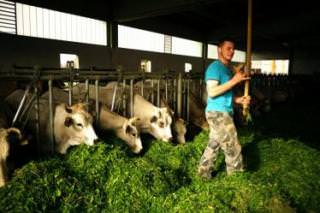
Only 20 months have passed since the “Federation of Damanhur” in Northern Italy started the latest pioneering self-sufficiency project of its community. They have called it “olio caldo 4“ (Hot Oil), and aim to achieve food sovereignty for the community within one year. Within the community of Damanhur, with its 600 members and 25 ‘nucleo’ families, the project was entrusted to the nucleo Prima Stalla. Capra Carruba reports.
As we speak of food sovereignty, this venture encompasses much more than food in Damanhur – it means being able to confront all conditions in life autonomously. We term this concept of self-sufficiency in an holistic interpretation, that includes food, furniture, clothes, means of transport and energy: “Olio Caldo”. We have created our own fashion, and introduced artistic elements typical for us in everyday life that characterize our cultural identity.
Taking into account how we all have been raised to be consumers, our dependency is not only economic, but most of all cultural; we need to change how we think about money, work, and needs. The changing of this imprinting has been a process within our community over many years in the last decades.
The first experience of Olio Caldo dates back to 1985/86. A small group of community members experimented for one year with an extreme condition of self-sufficiency. They left for the woods with ambitious milestones in mind, progressively retreating from a western lifestyle while slowly creating from scratch the basis of their own autonomy.
Precise rules determined what they could barter with the community to acquire—only goods they were not able to produce themselves. Olio Caldo 1 was an important experiment that has become a crucial reference point in our collective experience, framing our approach to self-sufficiency even for later generations who were not able to be there personally.
Three years later, in 1989/90, the experiment was opened to the entire community. In Olio Caldo 2, community members could opt to participate in varying degrees, where the most coherent included dressing in and eating only what had been produced within the community.
The next initiatives had less impact. Some aimed at merely cultural aspects, leaving aside food. In these collective dynamics everyone created objects of daily use, like chairs, spoons, forks, plates, in order to reflect the idea that we use what we create; thereby giving it a precious value over what we buy from the outside.
Where We Are Now
Olio Caldo 4 was able to create sufficient momentum to pave the way towards food sovereignty in two milestones:
A newly formed group of highly motivated people dedicated many volunteer hours to reach the goal for the entire community. After a first year of transition, important results became visible. The quality of vegetables improved, and the cultivated surface doubled. Some vegetables were in great supply, especially when other nucleo gardens were at top production.
An important factor for success was the gradual transition of responsibility to the most expert farmers in the community. The success gave credit to the new constellation and improved the overall economic performance of the cooperative. The amount of voluntary hours offered by Prima Stalla decreased the investment on behalf of the community, thus freeing resources for other projects.
A second major change was the creation of a council for our food sovereignty, facilitating between all elements of food production within Damanhur: the organic food store; all other nucleo families of the community with their family gardens; and the agricultural cooperative as legal entity.
In our jargon, we call this connection of different entities with a common theme: “Astronave” (Spaceship). The Astronave Olio Caldo not only created synergy, but it removed a leadership vacuum: We are not a business run from the top down, but a community with its own organically grown complexity and, sometimes also, contradictions. These were beautifully “fixed” by the “Captain”: A person with prestige, knowledge in the field, and social skills to mediate amongst all.
Within the new council, there is enormous potential to improve communication amongst all the united efforts: how to align strategies around what to plant, in what period, in order to meet the needs of all; what price policies to apply to the distribution within and outside the community; the uniting of forces to increase visibility on the internet; education on seasonal plants and their health benefits in our internal newspaper, etc.
Damanhur has always been interested in exchanging experiences with other Ecovillages and Communities. Our situation might be particular to us, because our agriculture is partly internal (family gardens), and partly official (agricultural cooperative), and yet all is run with community structures.
Being a Federation of communities, this hybrid model is part of our political strategy towards food sovereignty. Our official agriculture has to cope with market mechanisms; with financial and administrative requests of the Italian state; certification requisites for organic vegetables, etc. And yet, this professionalized cultivation will ensure food sovereignty in case we need to depend on it. In the meantime, we share our products with our local community in the farm restaurant and farm store.
Capra Caruba (born Christine Schneider) grew up in northern Germany, and has lived in Damanhur, Italy, since 2001 (www.damanhur.org). She has studied political science, and has worked as a consultant in organization development and training—currently in her own company, SOLIOS, commercializing products of green architecture. Capra teaches metaphysics and community building in the University of Damanhur.
Keep the conversation going with these pieces
There are no available blogs
Subscribe to our newsletter for fresh stories and ecovillage updates delivered to your inbox.
Get Plus and connect deeper with direct messaging, vetted content, private groups, and more.
We use cookies to improve your experience on our site. By using our site, you consent to cookies.
Manage your cookie preferences below:
Essential cookies enable basic functions and are necessary for the proper function of the website.
CleanTalk offers effective spam protection and website security solutions to enhance user experience.
Service URL: cleantalk.org (opens in a new window)
These cookies are needed for adding comments on this website.
These cookies are used for managing login functionality on this website.
Statistics cookies collect information anonymously. This information helps us understand how visitors use our website.
Google Analytics is a powerful tool that tracks and analyzes website traffic for informed marketing decisions.
Service URL: policies.google.com (opens in a new window)
A residential project: people live here as their primary home.
An institution, business, network, or project that isn’t a residence (e.g. a learning center, farm, or network with no one living there full-time).

{{ item.label }}
{{ item.value ? item.value : currencyFormat( item.amount ) }}
Subtotal
{{ currencyFormat( pricing_summary.total_amount ) }}
There are no results matching your search

