

Orissa is the poorest state of India with a population of 23% Indigenous peoples and Dalits. Though the state is gifted with abundant minerals and is generally prosperous, the tribal and Dalits peoples are poor as their lands are often misappropriated for mining, and other purposes. The rich culture of Adivasi – like much of the local community living, rituals and customs – is being eroded as modern ‘development’ creeps in.
Siddharthvillage has been instrumental in renewing culture and customs by initiating 2000+ villages, most of which are now recognized as ecovillages. Almost all the ecovillages have their own community cow shed, collective organic farming, community grain and seed banks, where traditional grains and seeds are stored for the villages, as well as different committees to assert and support their right to live in dignity by, for example, recording and archiving public information resources available from the government.
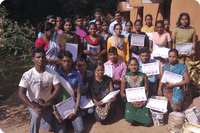
The Ecovillage Design Education (EDE) course with 26 indigenous participants took place from 2nd Nov -30th Nov 2012 at Siddharthvillage community school of ecology, Kakariguma. Reported from Siddharthvillage, Jatni.
The course emphasized the practical taking into consideration the background of the participants. With warm weather outside and heavy downpours, the programme commenced with the traditional ritual of lighting the lamp.
The first few days were focused on looking within, reflecting on the question: Who Am I?
“Here and Now” exercises designed to encourage participants to ponder on the ‘Life Road’ of each individual enabling the expression of happiest and saddest incidents, and providing the opportunity for group members to become closer to each other.
Understanding the term “Respect”, through role play, induced different attitudes towards ones self. The simulation game on communication, an exercise on giving and receiving feedback, nonviolent communication role plays by Karmi Besra, Pradyut nayak and John, all set the mood for joyful learning.
Understanding the term “value”, one’s own values in life and its importance in decision making with commitment and conviction, was another simple learning tool for understanding life .
Yet, WHO AM I? remained a puzzle for the participants to ponder over the passing days of the EDE training.
Each day saw early morning dynamic meditation, shramadan, evening feedback, and a cultural program that was composed of many songs on the subject of the days learning, and dance which is a vital expression of tribal culture.
The program focussed on simple explanations of Permaculture principles, together with a practical emphasis on conserving water, building A- frames, bio char, pesticides and hormones made of cow urine and cow dung, vermin compost, vermin culture, and chamber compost generated a lot of interest among participants.
Different unique methods of cultivation such as circle beds, double beds, Systemic Rice Intensification, known as ‘Madagascans method’ taught by Karmi and Pradyut, enthused participants to such an extent that John suggested the group organise an exhibition for the locals at the end of the programme.
The session on Ecological foot prints and the role of tribals in reduction of the same while exercising their own rights, by Pradyut, and peak oil talk entitled ‘no petrol and no diesel after 2020’ explained by Karmi, with 25 posters, helped participants to learn the importance of taking the issue of climate change seriously.
The understanding and analysis of present society in the context of tribal situations, conducting effective group discussions, and goal setting sessions, by Pradyut and Karmi, were helpful in understanding the need for strengthening ecovillages in the indigenous villages with the support of the Ecovillage Guide Lines document.
Sessions on different styles of leadership with the emphasis on situational leadership styles, effective for spreading ecovillages in Orissa, enabled participants to take many initiatives during the program and revealed that many of the participants have started the journey.
Nirmal conducted sessions on different Acts of the Indian government, such as NREGA, Right to Information act etc. Different schemes promoted by Govt., such as Public distributive system, integrated child development schemes, midday meals for school children, and other such schemes were explained so that the EDE participants will have the resources to take the initiative back home.
Listing economic leaks in the villages enabled the participants to understand the importance of formation of co-operatives in order to strengthen the economy of the villages.
Various herbal medicines for curing Tuberculosis, women diseases, Malaria, anemia, and water borne diseases were made by the participants, facilitated by Namita. The session on water and sanitation and its effectiveness of arresting seven water borne diseases was an eye opener for the participants.
Paper basket making, replacing plastic waste paper baskets, was taught by John and used for the last day exhibition. John also conducted sessions through various simulation games and exercises on different types of conflict, conflict resolutions , mapping conflict. Through process work approach, the conflict of the group members expressed in the sessions were used as part of the group learning.
Some outside resource people from govt circles – such as the horticulture department, were invited to contribute to the course some of their own learning. This resulted in participants learning grafting, budding and mushroom cultivation.
As the participants were linked with different tribal women’s organisations and they wanted to learn about accounting, Mr. Bhawani from the finance department was invited to teach them book keeping.
Participants learnt to make ecofriendly block bricks made of mud, sand and one percent cement cured for 21 days, and they constructed a building for rabbits with the empty bottles and the block bricks. John helped with the plan and design. This was a great attraction for the crowd on the last day’s exhibition for the locals. Both electronic and print media covered the news of this unique exhibition.
Participants in the oath taking ceremony of tribal ritual, expressed various dreams for realisation. Govinda says that he will start Green building co-operative society involving members of his village and samaj. Chandra says that she will start nurseries in her village and distribute trees to the villages to recreate forest. Lilly planned to start herbal medicine units in their eco village. Mamatha from Mayurbanj said that she will strengthen the village with the support of ecovillage guidelines. Pramila who was preoccupied with her village conflict said that she will try to resolve her village conflict after going back. Many others were very specific in stating that they will put into practice different types of ecological farming methods in their villages besides training other villages.
The climax of the course was the exhibition conducted by the course participants for the locals and it remains strong in our memory up to today. Even though it was meant to be one day exhibition it was kept open for three more days .
A big thanks goes to all those who encouraged us to organize this EDE course for indigenous people without many financial resources. All gratitude to every trainer who worked freely for the courses, Paola who encouraged us with ideas to raise funds, May East who took the time to speed up the certification process, and Siddharthvillage ecological farm that provided resources for food at very reasonable prices.
We are encouraged to organize another course for indigenous groups as the tribal women’s organization need human resources to support their respective organizations (Samajas).
John would like to conclude this report with the statement, ”what is destined to happen will happen and vice versa, so we will go on dreaming further and surrender to the Universe with humility”.
Keep the conversation going with these pieces
There are no available blogs
Subscribe to our newsletter for fresh stories and ecovillage updates delivered to your inbox.
Get Plus and connect deeper with direct messaging, vetted content, private groups, and more.
We use cookies to improve your experience on our site. By using our site, you consent to cookies.
Manage your cookie preferences below:
Essential cookies enable basic functions and are necessary for the proper function of the website.
CleanTalk offers effective spam protection and website security solutions to enhance user experience.
Service URL: cleantalk.org (opens in a new window)
These cookies are needed for adding comments on this website.
These cookies are used for managing login functionality on this website.
Statistics cookies collect information anonymously. This information helps us understand how visitors use our website.
Google Analytics is a powerful tool that tracks and analyzes website traffic for informed marketing decisions.
Service URL: policies.google.com (opens in a new window)
A residential project: people live here as their primary home.
An institution, business, network, or project that isn’t a residence (e.g. a learning center, farm, or network with no one living there full-time).

{{ item.label }}
{{ item.value ? item.value : currencyFormat( item.amount ) }}
Subtotal
{{ currencyFormat( pricing_summary.total_amount ) }}
There are no results matching your search

