
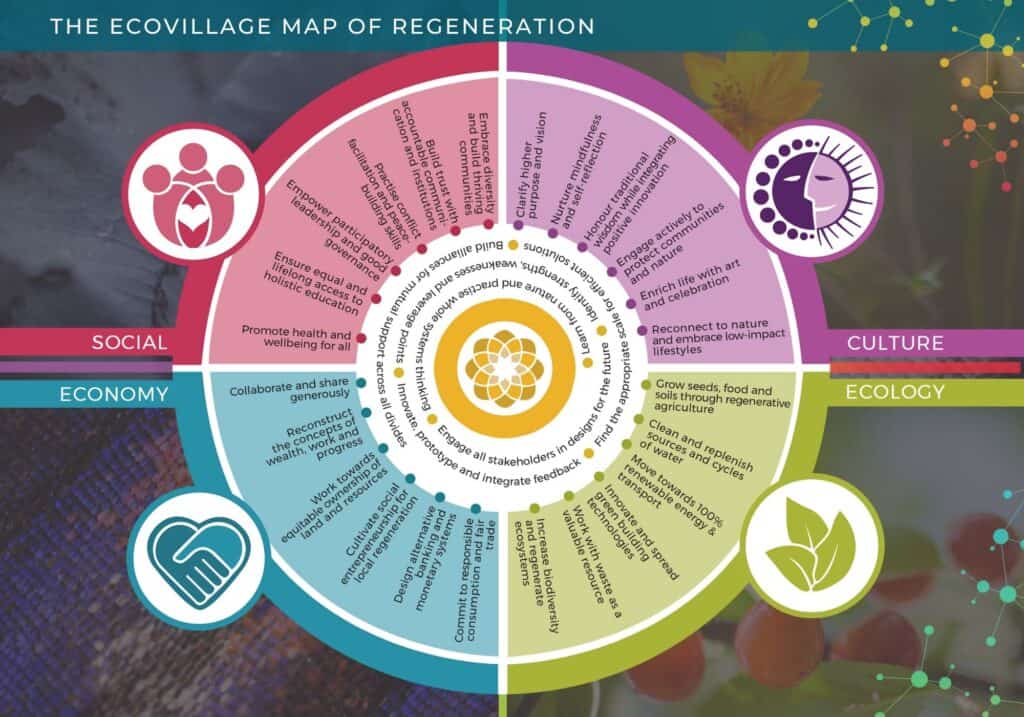

The Global Ecovillage Network embraces a holistic approach to sustainability, integrating the Social, Cultural, Ecological and Economic areas of existence. At the centre, we place the practice of integral design.
The 4 Areas of Regeneration and the central path of integral design make up the Ecovillage Map of Regeneration – our road map to the creation of ecovillages – intentional or traditional communities in urban and rural locations, using participatory processes to integrate the ecological, economic, social, and cultural areas in order to regenerate social and natural environments.
The Ecovillage Map of Regeneration is made up of 32 Ecovillage Principles – six in each Area of Regeneration and eight for the central path of integral design. It illustrates and distills years of experimentation and learning within the global network, as well as current research on resilience, sustainability and participatory design.
It is also the fruit of GEN’s longstanding collaboration with Gaia Education, and each organization’s common commitments to develop and promote holistic, community-led approaches to resilience and thriving on planet Earth.
The Ecovillage Map of Regeneration and Ecovillage Principles provide a map of crucial areas of attention when implementing ecovillage lifestyles for positive transformation. They are the basis of GEN’s activities, and a tool for learning, reflection, dialogue, research and design – usable by individuals, groups, projects, organisations, communities and countries.
These principles can be applied wherever a person is – in one’s individual life, in an organisation, in designing a new project, in formulating community-led development plans and more. They are meant to be an inspiration and road-map to implementing ecovillage lifestyles regardless of where or who you are.
The Ecovillage Map of Regeneration is the base for the Ecovillage Design Cards.

Ecovillagers tend to actively work to build trust, collaboration and openness between people, and to make sure they feel empowered, seen and heard. Ecovillages often provide a sense of belonging through community relationships, common projects, shared goals, and social processes, but do not demand that everyone is the same – unity and strength through diversity is important to the ecovillage movement.

Ecovillages aim to build or regenerate diverse cultures that support people to empower and care for each other, their communities and the planet. Many actively engage with practices that encourage people to feel deeply connected to each other, to the planet, and to themselves. Celebration, art, dance and other forms of creative expression are often embraced as central to thriving human life and communities. Most ecovillages find their own ways to talk about, connect with, respect and support life and the beings and systems that sustain it.

Ecovillages aim to access food, shelter, water and energy in ways that respect the cycles of nature. They aim to integrate humans with the rest of nature in ways that increase biodiversity and regenerate ecosystems, and that give people a chance to experience their interdependence with systems and cycles of life on a direct and daily basis.

Ecovillages aim to build economic practices and systems that contribute to sharing of resources, mutual support, and strong local economies and networks that serve the needs of local people and ecosystems. Most ecovillages actively work to provide sustainable alternatives to the mainstream economy and monetary system, and reclaim ways of thinking about wealth and progress that include all aspects of life. Local currencies, sharing, social entrepreneurship, circular economy and collaborative forms of ownership are central to many ecovillages.

Some principles apply to all Areas of Regeneration, and help bring them together in holistic designs for resilient communities and systems. In GEN, the integral design approach to design and regeneration is paired with a strong focus on collaboration and participation. This means that the principles of integral design are put into practice in ways that actively include everyone concerned and encourage transparency at every level.


