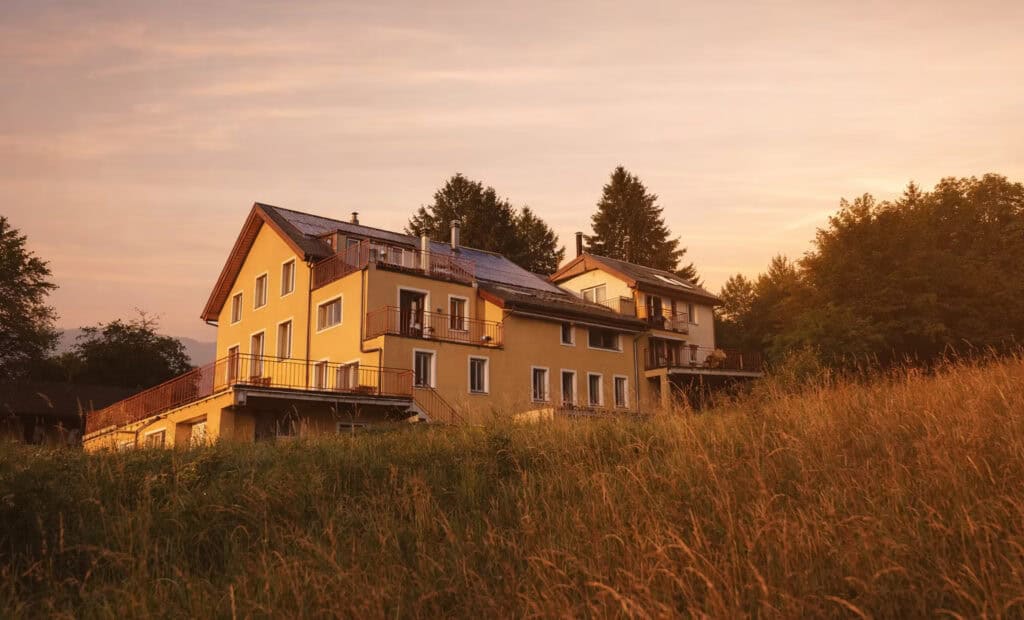
Yellowed hillside building complex at sunset, eco village architecture.

MOUL2

  • Communities

About the Communities

  • Mature
  • French
  • Social

Founding date

  • 2009-03-19

What we do

Créée en 2009, la société coopérative de construction et d’habitation MOUL2 se veut d’utilité publique, sans but lucratif et procure à ses membres des logements à prix favorables, tout en les soustrayant à la spéculation.

Our Vision

Les coopérateurs-trices – propriétaires et locataires à la fois, sont investi-e-s dans la rénovation des bâtiments, le développement de la structure, son entretien, le lieu de vie en général et le « vivre ensemble » en partageant des valeurs de durabilité, d’équité, d’autonomie, de cohérence et d’entraide.

 
  • Purpose
  • Social
  • Economical
  • Social
  • Languages
  • French
  • Italian
  • Community type
  • Cohousing
  • Activities
  • Permaculture
  • Property management
  • Farming
  • Construction

Video

  • 11 Total members
  • Open to new members
  • Open to visitors
  • Open to volunteers
Total
11

How to join

Nous écrire par mail: co*******@***il.com


Primary decision-making authority

  • All Community Members Together

The whole membership decides collectively.

Decision-making process

  • Consent-Based (Sociocracy)

Decisions proceed unless someone has a reasoned objection.

Governance structure

  • Collaborative/Horizontal

Power and responsibility are shared relatively equally among members.

Economic model

  • Independent Finances

Members maintain separate personal finances with minimal sharing.

Economic scenarios for this community

  • There is a one-time fee, investment, or share purchase to join the community separate from accessing housing
  • Members need to pay fees, dues, or similar to live there on a per month or per year basis
  • Members typically need to have their own job or other personal source of income to cover their expenses while living in the community?

Vehicle accessibility

  • Most / all people own their own vehicles
  • There are one or more community vehicles
  • There are car sharing opportunities in your community

Frequency of communal meals

  • 1-3 times per month

Significant food acquisition practices

  • Growing our own
  • Locally sourced
  • Wildcrafting / Foraging
  • Dumpster Diving / Food Surplus

Nature of social activity

  • People in the community regularly socialize together

Local connectedness

  • We have strong relationships with our local community

Friendliness of people and local government

  • There is a moderate amount of connection and collaboration between people and local government

Pet policy

  • Pets are allowed, no restrictions

Substance use culture

  • Substance use occurs primarily at celebrations or ceremonies

Practiced relationship models

  • Monogamy
  • Polyamory / Open relationships / Ethical Non-Monogamy (ENM)
  • Celibacy
  • Others

Member support features

  • Onsite or nearby medical facilities

DEI and anti-oppression training

  • No

Internal and external practices

  • Participates in protests and marches
  • Engages with local politics
  • Volunteers for organizations fighting for social justice
  • Supports or creates land reparation/reclamation projects
  • Organizes trainings and workshops for your members

Level of LGBTQIA+ inclusion

  • We don't track this information

Gender composition

  • We don't track this information

Age demographics

  • Multi-generational (all ages well represented)

Racial / ethnic demographics

  • We don't track this information

Socioeconomic and wealth composition

  • Mostly working class / lower income

Diversity representation

  • Physical / mobility limitations
  • Neurodiverse (ex. autism, ADHD, sensory processing etc.)
  • Chronic illness
  • Mental health conditions
  • Sensory differences (ex. blind, deaf, hard of hearing, etc. )
  • Learning disabilities (dyslexia, down's syndrome)

Guest Book

Written reviews are available for plus members. Click here to upgrade.

MOUL2

Promoted Needs and Offers

  • Events
2 months ago

IERI (International Ecovillage Research Institute) Research Lab

Logo of the Global Ecovillage Network with a stylized flower design.
The Research Lab is a new space for connection, exchange, and inspiration, bringing together researchers, practitioners, and students interested in ecovillages and regenerative communities. Our intention is to create a vibrant laboratory where we can learn from one another, strengthen collaborations, and advance collective knowledge. 📅 Date: Wednesday September 23rd🕓 Time: 10:30 Brazil / 13:30 UTC / 15:30 CEST (1.5 hour) Zoom link: https://unibas.zoom.us/j/61404061682   Register Here: https://unibas.zoom.us/meeting/register/io_jg3SJQGqRAaIi0eXazw Transitions towards the pluriverse: Place, difference, alliances and autonomy in two Latin American ecovillages Presented by Dr. Rebeca Roysen Professor at the Graduate Program in Tourism and Hospitality, Co-leader of the Sustainability Transitions and the Pluriverse of Alternatives (TranS-PlurAL) research group, Universidade do Vale do Itajaí (UNIVALI), Brazil This study proposes an alternative analytical framework for sustainability transitions research by drawing on critical scholarship on grassroots innovations and post-development studies. Rather than focusing on scalable innovations and socio-technical regime change, it introduces the concept of Transitions Towards the Pluriverse (TTP)—a bottom-up, decolonial, and context-sensitive approach that recognizes the diversity of transition pathways and places local communities and grassroots innovations at the center of transformations. Through two case studies of Latin American ecovillages, Dr. Roysen explores four key analytical dimensions—place, difference, alliances, and autonomy—to examine how ecovillages promote (or sometimes fail to promote) transitions towards the pluriverse. Whether you are an experienced researcher, a practitioner, or a student beginning your journey, you are warmly welcome to join us. We look forward to learning, exchanging ideas, and building this community together. Recent publications by Dr. Rebeca Roysen Roysen, R., Pereira Prado, M. M., Bruehwiler, N., Kos, L., & Koehrsen, J. (2026). Transitions towards the pluriverse: Place, difference, alliances and autonomy in two Latin American ecovillages. Sustainability Science. Roysen, R., Ayala, D. H. F., Ramos-Mejía, M., Kos, L., Bruehwiler, N., & Koehrsen, J. (2026). Replicating grassroots innovations in the Global South: A case study of ecovillages for marginalized groups in Colombia. Environmental Innovation and Societal Transitions. Roysen, R., Fagundes, G. M., Kos, L., Bruehwiler, N., & Koehrsen, J. (2025). Building a World-Ship: A decolonial approach to just energy transitions. Human Geography. More information: Ecovillage Research Global Ecovillage Network 
  • Events
2 weeks ago

Womens Tiny Mud House Workshop

Ecovillage Network logo with sun and moon symbols in purple.
Ecovillage Network logo with green leaves inside a circle.
Logo of the Global Ecovillage Network with a stylized flower design.
I’m Na, a regenerative designer, earthen builder and educator with the Global Ecovillage Network. I’m passionate about helping people step into action, however big or small. A women’s build I joined back in 2015 was a much needed transformational experience that set me on this path. Offering this workshop is a way of coming full circle and passing that same spark on. Sat 16 to Fri 22 January 2027 This is a hands-on workshop where you’ll learn earthen building techniques and build a tiny house from the earth up, with your own hands. Why tiny? A tiny house requires careful, creative design and asks – what space do we actually need to live? It uses far less material and takes less time to build, so it’s practical and economical. This also allows us to experience all stages of a house build, from design and brick-making to building and finishing. You’ll get your hands into every part of the build. We’ll work with mud brick (adobe), cob and bamboo, then earth plasters and finishes. This workshop is open to women of all ages and abilities are welcome. Come if you’re new and curious, if you want more practice on specific parts of a build, or simply to play in the mud with wonderful people. It’s genuinely good fun. We’ll be in my little forest, a small house on the edge of a village and national park, 20 km south of Chiang Mai, Thailand. You can stay on site in simple earthen dorms or tents, and we’ll share home-cooked Thai food in the cool, bright days of Thai winter. Read more and register here 
January 16, 2027 00:00 – January 22, 2027 23:59
  • Events
4 weeks ago

India Ecovillage Tour: February 8-22, 2027

Ecovillage Network logo with sun and moon symbols in purple.
Ecovillage Network logo with green leaves inside a circle.
Ecovillage Network logo with a heart-shaped handshake symbol.
Logo of the Global Ecovillage Network with a stylized flower design.
Logo of the Global Ecovillage Network with interconnected figures.
February 8–22, 2027 | Auroville, India Experience one of the world’s most extraordinary intentional communities Spend 15 days immersed in Auroville, an international township in southern India that is home to more than 3,000 people from over 60 nations. Founded with a vision of human unity, Auroville offers a fascinating opportunity to experience an established experiment in conscious, sustainable and community-centered living. Go beyond the typical visitor experience with an insider’s look at Auroville’s neighborhoods, permaculture farms, schools, spiritual centers, sustainable businesses and ecological projects. Meet long-term residents and community leaders, explore pioneering work in reforestation, organic farming, alternative building and education, and visit projects such as Sadhana Forest, Solitude Farm, the Solar Kitchen and Auroville Botanical Gardens. The journey also explores the spiritual and cultural dimensions of life in this part of India, with visits to the Matrimandir, nearby Tamil villages, Pondicherry and the sacred pilgrimage town of Tiruvannamalai. Along the way, enjoy local cuisine, yoga, meditation, beaches and other opportunities to experience the culture and rhythms of southern India. A great fit for: Those interested in intentional community, conscious living, spirituality, sustainability and regenerative practices; prospective community members; community founders looking for inspiration; and travelers seeking a deeper, more meaningful experience of India. Learn more about this tour: https://www.ecovillagetours.com/india
February 8, 2027 00:00 – February 22, 2027 23:59

Update to a Public Profile

  • Log in
  • Go to your profile page
  • Toggle on the "Put me on the People Map"
  • Save your profile

Information

Communities

A residential project: people live here as their primary home.

Organizations

An institution, business, network, or project that isn’t a residence (e.g. a learning center, farm, or network with no one living there full-time).

GeN logo with blue flower motif and plus sign in centre.

Become a + Community Member

  • Find people based on your community tool
  • Post Needs & Offers Listings and Events
  • Access to resources in the Members Library
  • Member badge on your community profile
  • View communities detailed reviews
  • Create Private Groups
I am an official member of this community
Disclaimer
I affirm that my information is accurate and I am authorized to manage this listing
Global Ecovillage Network member banner with FIC circle logo.

Free Plan

Free plan
Free

Intentional Advertising

  • Subtotal

    {{ currencyFormat( pricing_summary.total_amount ) }}

GeN logo with blue flower motif and plus sign in centre.

Become a + Member

  • Find communities based on your profile tool
  • Post Needs & Offers Listings and Events
  • Access to free resources in the Members Library
  • Member badge on your profile
  • View communities detailed reviews
  • Create Private Groups