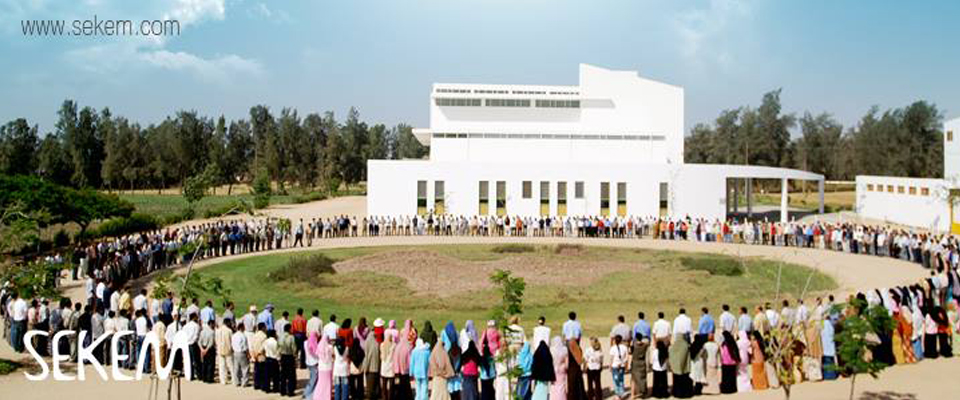
SEKEM

Global Ecovillage Network logo with Earth and eco-friendly design.
  • Communities

About the Communities

  • Established
  • Arabic
  • Spiritual
  • Rural

Founding year

  • 1977

What we do

When Dr. Ibrahim Abouleish returned to Egypt in 1977 to start the SEKEM initiative he had a strong vision deep in his heart and since then, SEKEM has become a role model for sustainable development with international recognition as shown by the Alternative Nobel Prize in 2003 and the Business for Peace Award in 2012.
SEKEM’s vision
SEKEM was founded with the idea of sustainable development and giving back to the community. The vision that brought Dr. Ibrahim Abouleish to dig the first well in the vast desert land still resounds in SEKEMs approach of conducting business. Like a compass, our vision, mission and values guide us in the everyday work in all SEKEM companies.
SEKEM’s mission
To realise our Vision for Sustainable Development in Egypt:

  • We establish Biodynamic agriculture as the competitive solution for the environmental, social and food security challenges of the 21st century.
  • We support individual development through holistic education and medical care.
  • We create workplaces reflecting human dignity and supporting employee development.
  • We build successful business models in accordance with ecological and ethical principles.
  • We innovate for sustainable development through research in natural and social sciences.
  • We locally and globally advocate for a holistic approach to sustainable development.

SEKEM’s core values
In nature, every organism is independent and at the same time systemically inter-connected to other organisms. Inspired by ecological principles, representing the wisdom of nature and the universe, we continuously strive to gain and sustain a harmonious balance between the following polarities and to integrate them into our development.

  • Purpose
  • Spiritual
  • Languages
  • Arabic
  • English
  • German
  • Community type
  • Youth-led
  • Intentional Neighborhoods
  • Spiritual Retreat Centers
  • Activities
  • Ecological Restoration

Commemorative dates

  • January 1, 1977
  • Started living together

Video

  • Open to new members
  • Open to visitors
Total
68

Guest Book

Written reviews are available for plus members. Click here to upgrade.

Our Community Members

Promoted Needs and Offers

  • Promoted
Need
  • Promoted
Need
  • Volunteering
1 week ago

Social Media Intern

Ecovillage Network logo with sun and moon symbols in purple.
Ecovillage Network logo with green leaves inside a circle.
Ecovillage Network logo with a heart-shaped handshake symbol.
Logo of the Global Ecovillage Network with a stylized flower design.
Logo of the Global Ecovillage Network with interconnected figures.
Social Media Intern for GEN International Hours: Up to 20/month, flexible around your schedule and availability Location: Remote, work with Eva Goldfarb Focus: Instagram + LinkedIn (TikTok if you’re into it!) Hi! I’m Eva, and I run social media for GEN International — the global network connecting ecovillages, intentional communities, and regenerative culture-builders across every continent. I’m looking for a co-conspirator to help me tell the stories of the people quietly building the future: off-grid villages in the Philippines, permaculture farms in Senegal, urban cohousing projects in Berlin, elders passing down land wisdom in the Andes. It’s a wildly rich, wildly underrepresented world, and I want more people to fall in love with it the way I have. What you’ll actually do: Dream up and create content for Instagram and LinkedIn (reels, carousels, stories, captions that don’t sound like a corporate newsletter) Dig into our global network and turn your findings into stories people want to share Pitch your own ideas. If there’s a series, a theme, a format, or a corner of the network that lights you up, that’s what I want you to focus on. What we’re looking for: A natural storyteller, someone who can spot the human thread in a project update or a photo from a faraway village Genuinely curious about ecovillages, sustainability, intentional community, regenerative living Self-motivated and communicative; this is a flexible, trust-based role Why this role: This isn’t a “post 3x a week and don’t ask questions” internship. You’ll have real creative freedom to work on what excites you, learn how a global grassroots network tells its story, and build a portfolio full of meaningful, purpose-driven content. Plus you’ll be talking to people living some of the most interesting, intentional lives on the planet. If storytelling for a better world sounds like your kind of fun, let’s talk.
  • Promoted
Need
  • Events
8 years ago

International Communal Studies Assoc July 2019

The ICSA, founded in 1985, is a network of scholars and communitarians that gathers every three years, usually on the site of a contemporary intentional community. Recent hosts include Tamera, Findhorn, Emek Yizrael, Damanhur, and ZEGG. The 2019 host communities are part of the Camphill movement, an international network of schools, villages, and urban households where people with and without intellectual disabilities create life together. Most Camphill communities host biodynamic farms or other environmental initiatives. Call For Papers: Our thirteenth international conference will explore strategies that intentional communities use to promote the inclusion and empowerment of persons of diverse abilities, cultures, races, economic backgrounds, religions, ages, genders, and sexualities. We especially welcome proposals related to intentional communities and community movements that focus on the experiences of particular groups that have historically been marginalized—as, for example, the Camphill movement does for persons with intellectual disabilities. What can the field of communal studies learn from the unique experiences of such communities? We also especially welcome proposals that explore the implications of community choices that seek to increase or to limit diversity. How have communities succeeded or failed in their efforts to increase diversity or strengthen inclusion? Under what circumstances is it appropriate or necessary for an intentional community to limit certain forms of diversity? What is the relationship between the mere presence of previously excluded persons in a community, and the full inclusion and empowerment of those persons? What lessons might intentional communities share with other persons and organizations committed to diversity, inclusion, and empowerment? We welcome proposals in the following categories: 1) scholarly papers, 2) scholarly panels with 2-4 presenters, 3) workshops, and 4) cultural events.

Information

Communities

A residential project: people live here as their primary home.

Organizations

An institution, business, network, or project that isn’t a residence (e.g. a learning center, farm, or network with no one living there full-time).

Become a + Community Member

  • Send Direct Messages and see contact information
  • Find communities based on your profile tool
  • Post Needs & Offers Listings and Events
  • Access to resources in the Members Library /// like vetted documents uploaded by communites (e.g. bylaws )
  • Member badge on your profile
  • View communities detailed reviews
  • Create Private Groups
I am an official member of this community
Disclaimer
I affirm that my information is accurate and I am authorized to manage this listing

Free Plan

Free plan
Free

Intentional Advertising

  • Subtotal

    {{ currencyFormat( pricing_summary.total_amount ) }}

Become a + Member

  • Send Direct Messages and see contact information
  • Find communities based on your profile tool
  • Post Needs & Offers Listings and Events
  • Access to free resources in the Members Library
  • Member badge on your profile
  • View communities detailed reviews
  • Create Private Groups