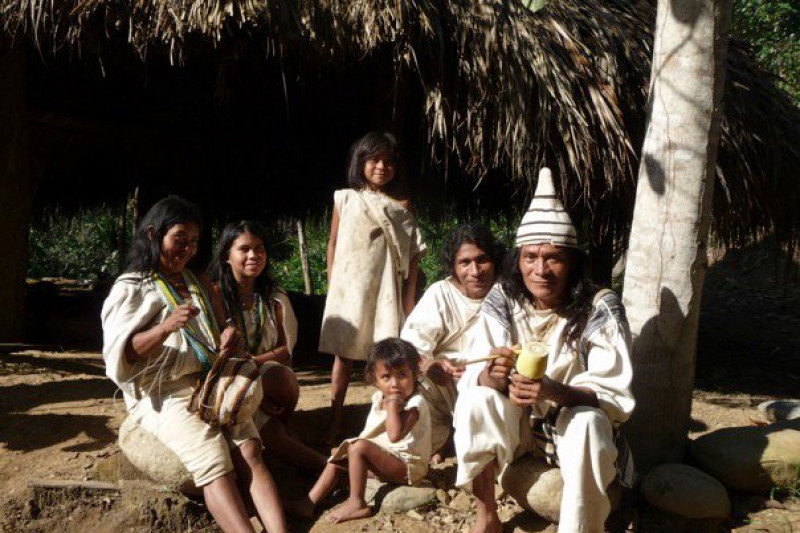
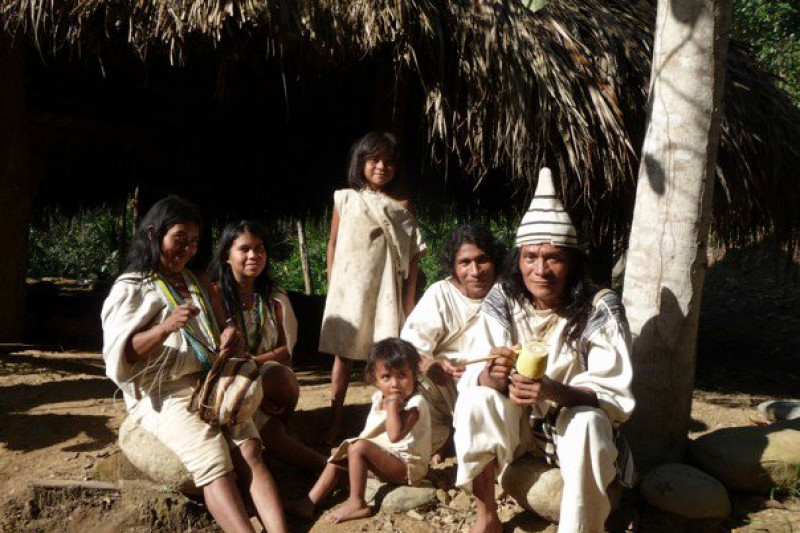
Group of indigenous people sitting and standing outdoors near a thatched hut.

Fundacion Escuela Sintana y Tierra Negra

  • Communities

About the Communities

  • Forming
  • Spanish
  • Traditional
  • Rural

Founding year

  • 2012

What we do

General goals: To promote and generate cultural exchanges, studies with scientific investigation, benevolent acts, improvements to the quality of life and common well-being, and provide social services to the indigenous communities. To be a bridge between the traditional wisdom of those who live integrated with nature, and the actions of contemporary urban society, and to contribute to the dynamic evolution of the diverse branches of human life.
Objetivos Generales: Promover y realizar el intercambio cultural, el estudio en la investigación científica, acciones de beneficencia, el mejoramiento de la calidad de vida, el bienestar común, el servicio social entre las comunidades indígenas, ser un puente entre la sabiduría de las comunidades tradicionales indígenas que viven integradas a la naturaleza, y las actividades urbanas de la sociedad contemporánea, para contribuir a una evolución dinámica en los diversos campos de la vida humana.

  • Purpose
  • Traditional
  • Languages
  • Spanish
  • English
  • Community type
  • Intentional Neighborhoods
  • Land-Based Communities

Commemorative dates

  • January 1, 2012
  • Started planning
  • January 1, 2012
  • Started living together
  • Open to new members
  • Open to visitors
Total
8

How to join

Please contact us.

Guest Book

Written reviews are available for plus members. Click here to upgrade.

Location

  • Colombia

Fundacion Escuela Sintana y Tierra Negra

Promoted Needs and Offers

  • Events
3 months ago

IERI (International Ecovillage Research Institute) Research Lab

Logo of the Global Ecovillage Network with a stylized flower design.
The Research Lab is a new space for connection, exchange, and inspiration, bringing together researchers, practitioners, and students interested in ecovillages and regenerative communities. Our intention is to create a vibrant laboratory where we can learn from one another, strengthen collaborations, and advance collective knowledge. 📅 Date: Wednesday September 23rd🕓 Time: 10:30 Brazil / 13:30 UTC / 15:30 CEST (1.5 hour) Zoom link: https://unibas.zoom.us/j/61404061682   Register Here: https://unibas.zoom.us/meeting/register/io_jg3SJQGqRAaIi0eXazw Transitions towards the pluriverse: Place, difference, alliances and autonomy in two Latin American ecovillages Presented by Dr. Rebeca Roysen Professor at the Graduate Program in Tourism and Hospitality, Co-leader of the Sustainability Transitions and the Pluriverse of Alternatives (TranS-PlurAL) research group, Universidade do Vale do Itajaí (UNIVALI), Brazil This study proposes an alternative analytical framework for sustainability transitions research by drawing on critical scholarship on grassroots innovations and post-development studies. Rather than focusing on scalable innovations and socio-technical regime change, it introduces the concept of Transitions Towards the Pluriverse (TTP)—a bottom-up, decolonial, and context-sensitive approach that recognizes the diversity of transition pathways and places local communities and grassroots innovations at the center of transformations. Through two case studies of Latin American ecovillages, Dr. Roysen explores four key analytical dimensions—place, difference, alliances, and autonomy—to examine how ecovillages promote (or sometimes fail to promote) transitions towards the pluriverse. Whether you are an experienced researcher, a practitioner, or a student beginning your journey, you are warmly welcome to join us. We look forward to learning, exchanging ideas, and building this community together. Recent publications by Dr. Rebeca Roysen Roysen, R., Pereira Prado, M. M., Bruehwiler, N., Kos, L., & Koehrsen, J. (2026). Transitions towards the pluriverse: Place, difference, alliances and autonomy in two Latin American ecovillages. Sustainability Science. Roysen, R., Ayala, D. H. F., Ramos-Mejía, M., Kos, L., Bruehwiler, N., & Koehrsen, J. (2026). Replicating grassroots innovations in the Global South: A case study of ecovillages for marginalized groups in Colombia. Environmental Innovation and Societal Transitions. Roysen, R., Fagundes, G. M., Kos, L., Bruehwiler, N., & Koehrsen, J. (2025). Building a World-Ship: A decolonial approach to just energy transitions. Human Geography. More information: Ecovillage Research Global Ecovillage Network 
Need

Update to a Public Profile

  • Log in
  • Go to your profile page
  • Toggle on the "Put me on the People Map"
  • Save your profile

Information

Communities

A residential project: people live here as their primary home.

Organizations

An institution, business, network, or project that isn’t a residence (e.g. a learning center, farm, or network with no one living there full-time).

GeN logo with blue flower motif and plus sign in centre.

Become a + Community Member

  • Find people based on your community tool
  • Post Needs & Offers Listings and Events
  • Access to resources in the Members Library
  • Member badge on your community profile
  • View communities detailed reviews
  • Create Private Groups
I am an official member of this community
Disclaimer
I affirm that my information is accurate and I am authorized to manage this listing
Global Ecovillage Network member banner with FIC circle logo.

Free Plan

Free plan
Free

Intentional Advertising

  • Subtotal

    {{ currencyFormat( pricing_summary.total_amount ) }}

GeN logo with blue flower motif and plus sign in centre.

Become a + Member

  • Find communities based on your profile tool
  • Post Needs & Offers Listings and Events
  • Access to free resources in the Members Library
  • Member badge on your profile
  • View communities detailed reviews
  • Create Private Groups