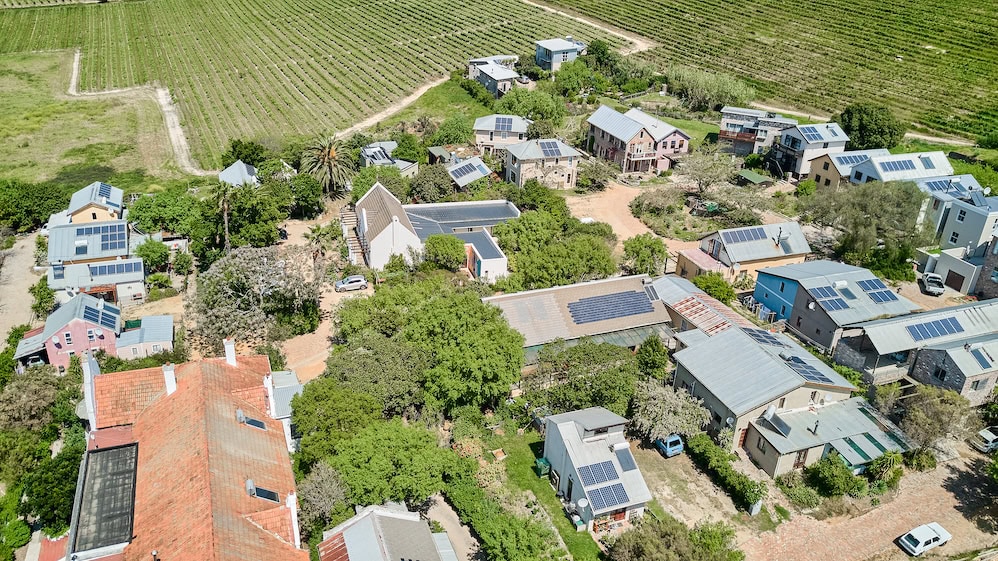
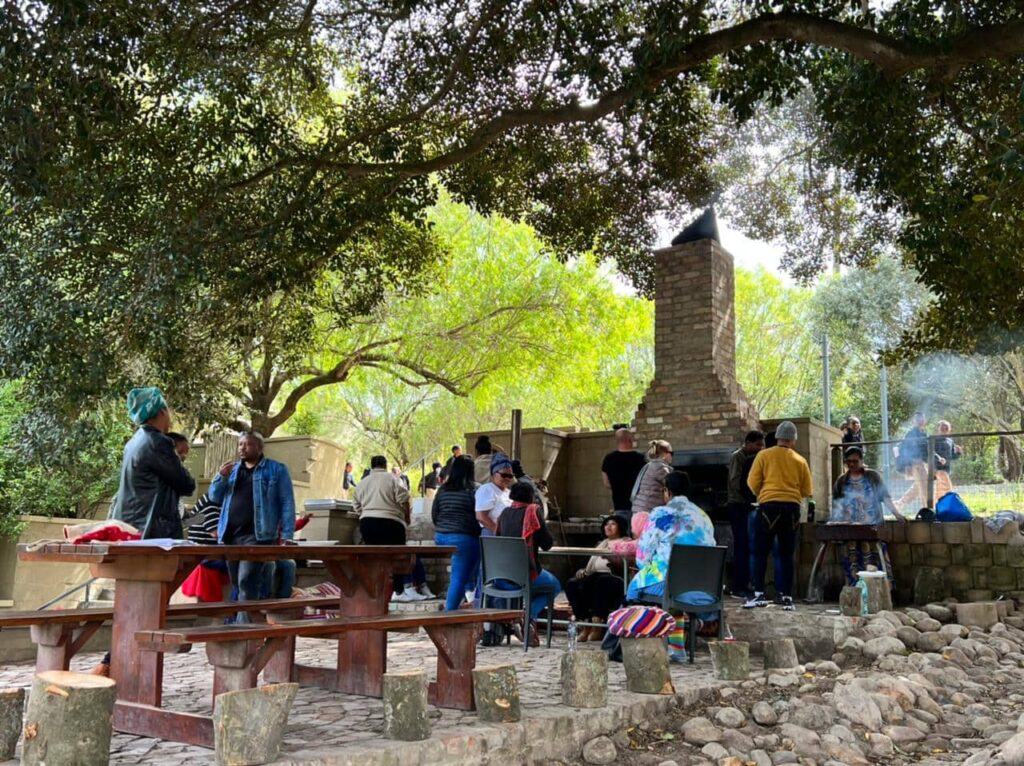
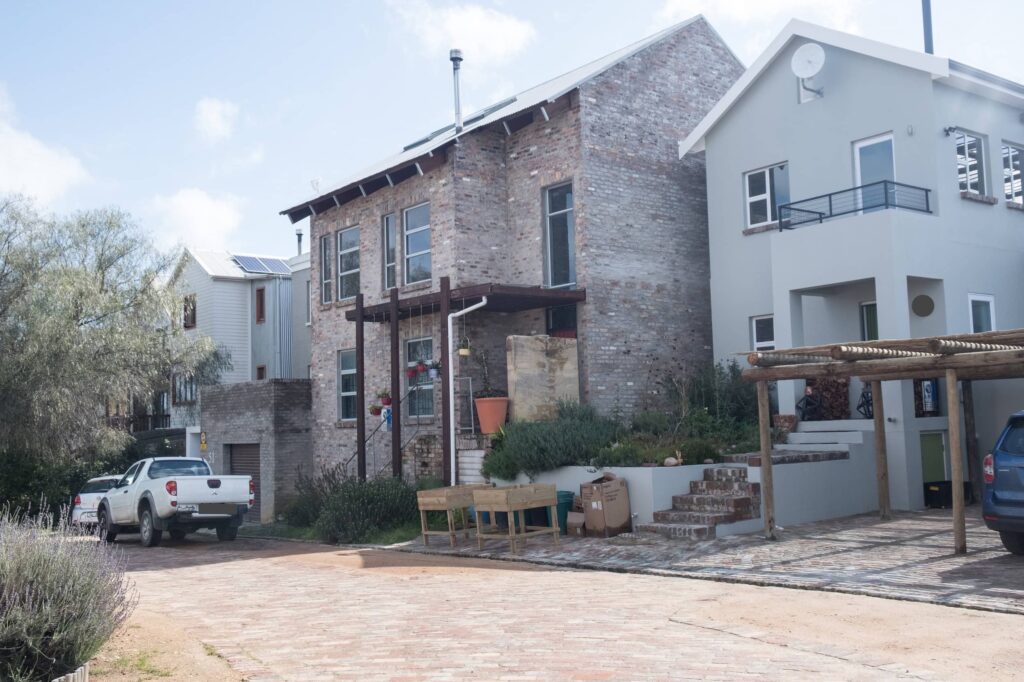
Aerial view of a sustainable eco-village with solar panels and green spaces.

The Sustainability Institute and Lynedoch Eco-Village

  • Communities

About the Communities

  • Established
  • English
  • Ecological
  • Rural

Founding year

  • 1999

What we do

Founded in 1999, the Sustainability Institute is an intergenerational learning and living imaginarium that challenges existing paradigms by blending creativity, innovation and imagination to nurture regenerative ecological and social ways of being. The SI is a place where research, practice and community converge. We are located outside the South African university town of Stellenbosch. Surrounded by the breathtaking beauty of the Cape’s towering mountains and rooted in an agricultural community needing to break free from its’ racial past, the Sustainability Institute provides a space for people to explore an approach to creating a more equitable society that lives in a way that sustains rather than destroys the eco-system within which all society is embedded.
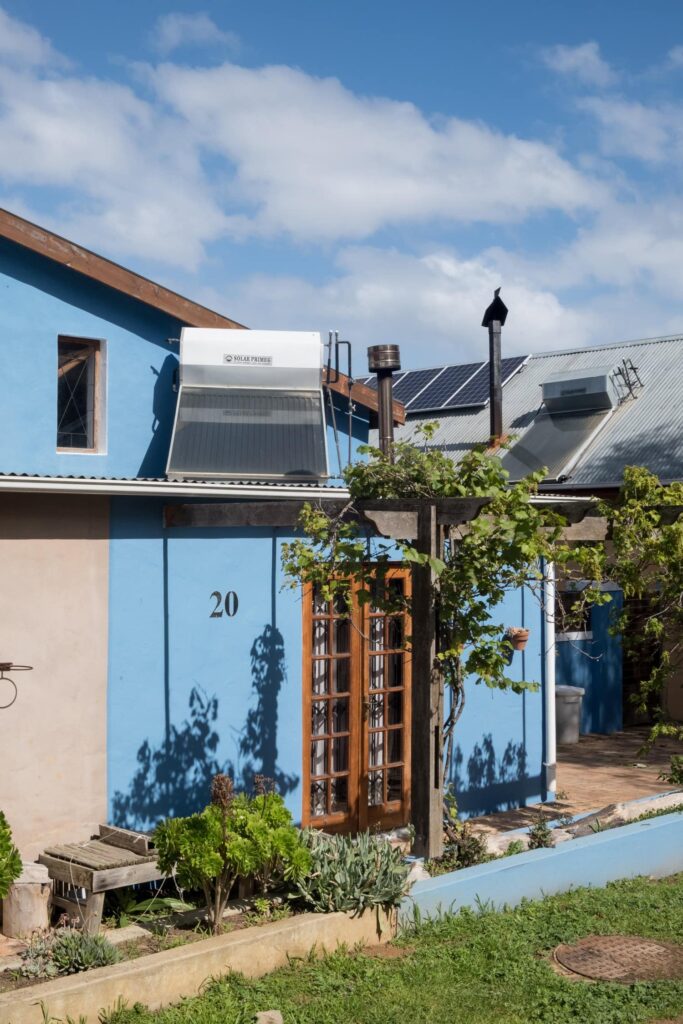
The Sustainability Institute forms part of the wider Lynedoch EcoVillage. The Eco-Village is an ecologically designed, socially mixed community built around a learning precinct. It is a mixed community of 30 families from diverse racial and social-economic groups built around a child-centered learning precinct, which is a financially and economically viable community requiring no external funding to sustain itself. It is also a working example of a livable ecologically designed urban system that challenges the notion that sustainable development and ecological building is too expensive. Various ecological design approaches have been integrated into the building of the Eco-Village. https://lynedochecovillage.wordpress.com/
Our history has been written up in this book (https://www.sustainabilityinstitute.net/wp-content/uploads/2025/07/SI-20YRS-Full-Doc-small-spreads.pdf).
For more information on the Sustainability Institute, visit www.sustainabilityinstitute.net

  • Purpose
  • Ecological
  • Languages
  • English
  • Community type
  • Ecovillage
  • Intentional Neighborhoods
  • Land-Based Communities
  • Activities
  • Ecological Restoration
  • Permaculture

Commemorative dates

  • January 1, 1999
  • Started living together

Video

Gallery

  • Open to new members
  • Open to visitors
Total
90

How to join

This will depend on whether houses are available for sale or rent. Best would be to enquire with in**@*********************te.net for more information. Some homestay opportunities are also available.
Guest Book

Written reviews are available for plus members. Click here to upgrade.

Our Members

Sustainability Institute logo with tree and circular lines.

Amelia Pretorius

Lynedoch Eco-Village at the Sustainability Institute
South Africa

Location

  • South Africa

The Sustainability Institute and Lynedoch Eco-Village

Promoted Needs and Offers

  • Events
3 months ago

IERI (International Ecovillage Research Institute) Research Lab

Logo of the Global Ecovillage Network with a stylized flower design.
The Research Lab is a new space for connection, exchange, and inspiration, bringing together researchers, practitioners, and students interested in ecovillages and regenerative communities. Our intention is to create a vibrant laboratory where we can learn from one another, strengthen collaborations, and advance collective knowledge. 📅 Date: Wednesday September 23rd🕓 Time: 10:30 Brazil / 13:30 UTC / 15:30 CEST (1.5 hour) Zoom link: https://unibas.zoom.us/j/61404061682   Register Here: https://unibas.zoom.us/meeting/register/io_jg3SJQGqRAaIi0eXazw Transitions towards the pluriverse: Place, difference, alliances and autonomy in two Latin American ecovillages Presented by Dr. Rebeca Roysen Professor at the Graduate Program in Tourism and Hospitality, Co-leader of the Sustainability Transitions and the Pluriverse of Alternatives (TranS-PlurAL) research group, Universidade do Vale do Itajaí (UNIVALI), Brazil This study proposes an alternative analytical framework for sustainability transitions research by drawing on critical scholarship on grassroots innovations and post-development studies. Rather than focusing on scalable innovations and socio-technical regime change, it introduces the concept of Transitions Towards the Pluriverse (TTP)—a bottom-up, decolonial, and context-sensitive approach that recognizes the diversity of transition pathways and places local communities and grassroots innovations at the center of transformations. Through two case studies of Latin American ecovillages, Dr. Roysen explores four key analytical dimensions—place, difference, alliances, and autonomy—to examine how ecovillages promote (or sometimes fail to promote) transitions towards the pluriverse. Whether you are an experienced researcher, a practitioner, or a student beginning your journey, you are warmly welcome to join us. We look forward to learning, exchanging ideas, and building this community together. Recent publications by Dr. Rebeca Roysen Roysen, R., Pereira Prado, M. M., Bruehwiler, N., Kos, L., & Koehrsen, J. (2026). Transitions towards the pluriverse: Place, difference, alliances and autonomy in two Latin American ecovillages. Sustainability Science. Roysen, R., Ayala, D. H. F., Ramos-Mejía, M., Kos, L., Bruehwiler, N., & Koehrsen, J. (2026). Replicating grassroots innovations in the Global South: A case study of ecovillages for marginalized groups in Colombia. Environmental Innovation and Societal Transitions. Roysen, R., Fagundes, G. M., Kos, L., Bruehwiler, N., & Koehrsen, J. (2025). Building a World-Ship: A decolonial approach to just energy transitions. Human Geography. More information: Ecovillage Research Global Ecovillage Network 
Need

Update to a Public Profile

  • Log in
  • Go to your profile page
  • Toggle on the "Put me on the People Map"
  • Save your profile

Information

Communities

A residential project: people live here as their primary home.

Organizations

An institution, business, network, or project that isn’t a residence (e.g. a learning center, farm, or network with no one living there full-time).

GeN logo with blue flower motif and plus sign in centre.

Become a + Community Member

  • Find people based on your community tool
  • Post Needs & Offers Listings and Events
  • Access to resources in the Members Library
  • Member badge on your community profile
  • View communities detailed reviews
  • Create Private Groups
I am an official member of this community
Disclaimer
I affirm that my information is accurate and I am authorized to manage this listing
Global Ecovillage Network member banner with FIC circle logo.

Free Plan

Free plan
Free

Intentional Advertising

  • Subtotal

    {{ currencyFormat( pricing_summary.total_amount ) }}

GeN logo with blue flower motif and plus sign in centre.

Become a + Member

  • Find communities based on your profile tool
  • Post Needs & Offers Listings and Events
  • Access to free resources in the Members Library
  • Member badge on your profile
  • View communities detailed reviews
  • Create Private Groups